
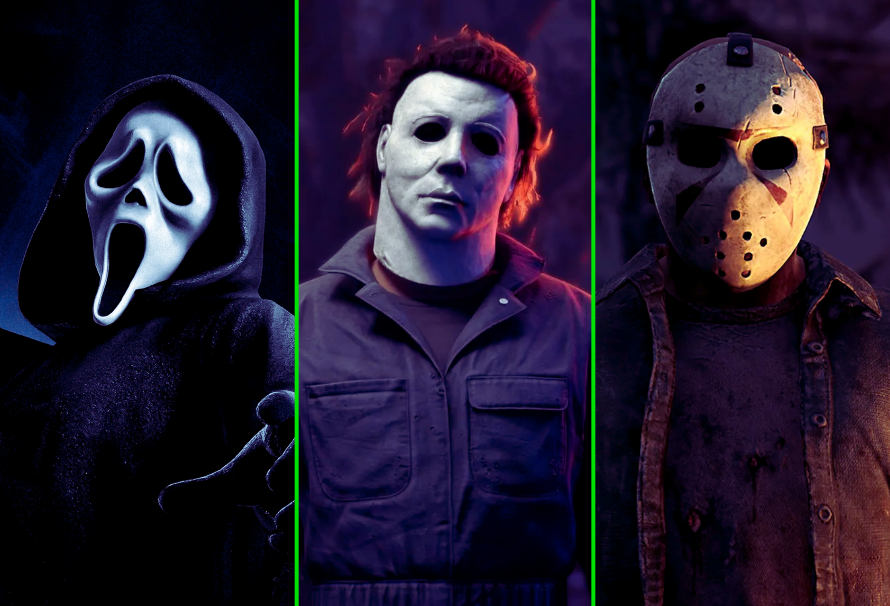
For more than forty years, horror and video games have been comfortable bedfellows. Horror movies and television shows offer compelling, visceral experiences exclusive to the genre. It is hardly surprising that generations of gamers have yearned to bring that experience home. Adding an interactive element that big- and small-screen icons simply cannot match.
From Ridley Scott’s Alien terrifying players on the Atari 2600 to horror legends like Michael Myers and Jason Voorhees dropping into Fortnite, here is the history of horror IPs in video games.
Kicking things off in a mainstream way back in 1982, Ridley Scott’s seminal space horror flick Alien was adapted for Atari’s 8-bit 2600 home console by programmer Doug Neubauer and 20th Century Fox. Immensely hamstrung by technical limitations, the game required human imagination to fill in the gaps to create terror. Neubauer’s Alien played like an odd version of Pac-Man: ghosts became Xenomorphs, and dots became alien eggs that players crushed for points while outrunning adult Xenomorphs. Though simplistic and hardly a match for the source material, Alien kicked off the long-standing trend of officially licensed horror video games.
Just one year later, in 1983, The Texas Chainsaw Massacre received the licensed video game treatment courtesy of development studio VSS. Also targeting the Atari 2600, it flipped the script by putting players in control of the chainsaw-wielding Leatherface. The goal was to move left to right, carving up as many hapless victims as possible for a high score before the chainsaw ran out of fuel. While the low-fidelity visuals weren’t graphic, many stores banned the game for its violent themes, which helped it fail commercially.
The next classic to get a home adaptation in 1983 was John Carpenter’s Halloween. Unlike previous efforts, Halloween made a genuine attempt to capture the atmosphere of its source material. Set across a two-story home, this side-scrolling title tasked players with rescuing children while avoiding Michael Myers.
Where Halloween succeeded was its attention to horror mechanics:
Explicit pixelated stabbings and decapitations.
Random blackout mechanics that cut the lights.
A nifty chiptune rendition of the iconic Halloween theme that played whenever Michael Myers appeared on screen.
While other popular properties like A Nightmare on Elm Street, Friday the 13th, and The Evil Dead carved their way onto 8-bit systems like the ZX Spectrum, Commodore 64, and NES, it was the arrival of 16-bit hardware that truly ushered in a new era of horror adaptations.
The 16-bit era brought a substantial leap in graphical fidelity and a wave of horror IPs to home computers and consoles. The Commodore Amiga and Atari ST hosted a bevy of licensed titles, including:
Bram Stoker’s Dracula
Elvira: Mistress of the Dark
Fright Night
Gremlins 2: The New Batch
Jaws: The Computer Game
Clive Barker’s Nightbreed (released in both action and interactive movie formats)
Predator
The Addams Family
The Twilight Zone (released on Amiga in 1988 as a text adventure by First Row Software)
When discussing 16-bit gaming horror, Alien 3 on the Sega Genesis / Mega Drive stands in a class of its own. Putting players into the boots of Ellen Ripley, Alien 3 (developed by Probe Software in October 1992) was a white-knuckle, run-and-gun platformer with incredible style.
Ripley blasted through hordes of Xenomorphs to rescue prisoners while a dark, FM-synth soundtrack provided unmatched atmosphere. Beyond its presentation, Alien 3 was a genuinely great game featuring responsive platforming, sharp shooting mechanics, and some of the most fluid animation on Sega’s 16-bit hardware.
While scattershot tie-ins like The X-Files, The Blair Witch Project, and The Mummy populated the 32-bit era, the modern era has seen a full-blown resurgence of horror adaptations. In fact, horror fans have never eaten so well.
A significant reason legacy 1970s and 1980s slasher icons continue to find new audiences is developer IllFonic. Specializing in asymmetrical game design and extraction mechanics, IllFonic has spearheaded several notable modern adaptations:
Friday the 13th: The Game
Predator: Hunting Grounds
Killer Klowns from Outer Space: The Game
Halloween: The Game
Beyond IllFonic, larger publishers and studios have stepped up. Saber Interactive brought cinematic terror to life with Evil Dead: The Game, A Quiet Place: The Road Ahead, the wildly popular co-op shooter World War Z, and the intriguing Clive Barker’s Hellraiser: Revival. Meanwhile, Nightdive Studios remastered 2002’s squad-based cult shooter The Thing, bringing its paranoia mechanics and infection systems to a modern audience with updated visuals.
Virtual Reality has opened another visceral avenue for the genre:
Alien: Rogue Incursion: Creep through dark corridors hunting Xenomorphs.
The Exorcist: Legion VR: Face disturbing exorcisms up close.
Blair Witch: VR Edition: Experience psychological dread in dense woods.
Paranormal Activity: The Lost Soul: Test your heart rate against ruthless jump scares.
Much like a Xenomorph, horror gaming is endlessly adaptable. Today, iconic movie monsters have found a natural home within live-service multiplayer games.
The premier home for horror crossovers is Dead by Daylight. As an asymmetrical survival horror game, Dead by Daylight features an expansive library of DLC chapters containing iconic killers and locations from Alien, Child’s Play, Ringu, Hellraiser, Saw, Halloween, A Nightmare on Elm Street, and The Texas Chainsaw Massacre.
Other major live-service titles featuring horror icons include:
Call of Duty: Warzone: Hosted seasonal crossover events featuring Scream, Saw, Evil Dead II, and Child’s Play.
Fortnite: Its annual Fortnitemares event has introduced skins and items based on Universal Classic Monsters, Alien, Predator, and Halloween.
Hunt: Showdown 1896: Introduced a 19th-century variation of Ghost Face, fitting seamlessly into its grim Louisiana Bayou setting.

 Add us to your RSS feed