
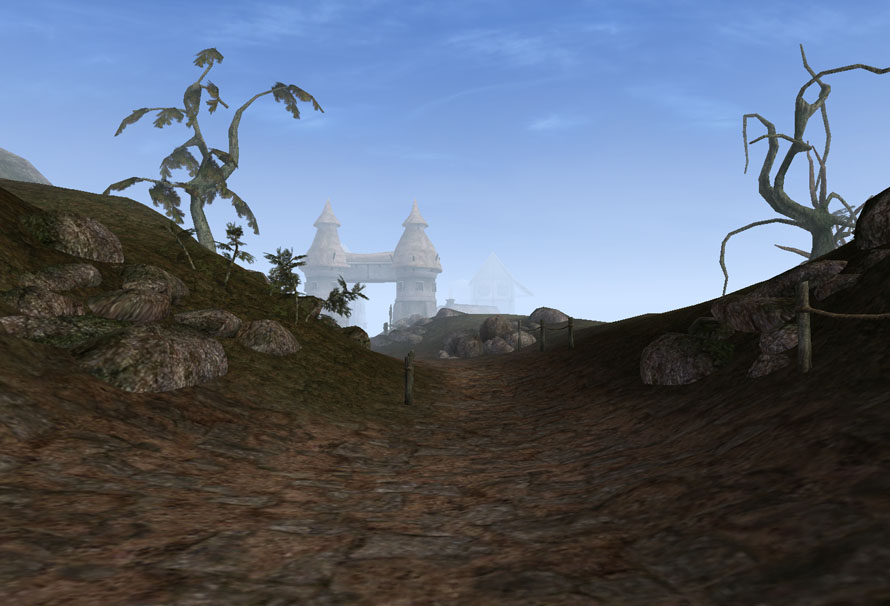
20 years ago the world was a different place. Social media wasn’t a thing yet, double denim was in, and Terry Pratchett was releasing his Magnum Opus – Night Watch. Over in video gaming, the followup to Daggerfall burst out into the world. The Elder Scrolls III: Morrowind was a massive leap forward for the series and today, 20 years later, it still holds a firm grip over the hearts of many.
It’s rare for a game from so long ago to still be so entrenched in the zeitgeist, with many equally genre-shifting games becoming little more than footnotes to history. It might not be the most popular game in 2022 but to its fans, there’s nothing that’s ever managed to replace it. Simply say ‘Morrowind’ in some circles and unfortunately you’re in for a 12 hour lecture about its many highlights (and its occasional flaw).
As it’s 20 years old as of the 1st of May, 2022, we thought we’d take a look back at Morrowind, why it’s remained so popular, and why you should check it out if you haven’t so far.

One of the dullest things you can say about a game is that it’s playable. What an awful phrase, but yet, Morrowind remains incredibly playable. Today this would go without mention as most games are smooth, slick affairs that don’t throw confusing mechanics at you. In 2002, however, the gaming landscape was a vastly different affair, especially when it came to RPGs.
You see we just didn’t have the rules then. In the 90s games were incredibly ambitious and experimental but often that experimentation came at the cost of playability. Many games had wonderful worlds, ideas that leapt out of the screen at you, but mechanics that just…weren’t great.
Morrowind, unlike many of its predecessors, was playable. It, alongside games like Halo which released the year before, helped turn gaming from a load of obtuse experiments into an industry. Playing games had fewer barriers to entry suddenly, helping gaming take over the world.
That’s not to say that Morrowind doesn’t have its own swathe of obtuseness. Dice rolls fill every skill check but they’re hidden from the player, meaning you have no real idea why you’ve failed to hit that Kwama Forager. It’s also populated entirely by NPCs who only have a vague – at best – grasp of directions.
Which in itself may be another reason it’s still held in such high regard today. The Dark Souls series took vagueness and ran with it, making an entire series about hints and whispers of story hidden in weird worlds. Morrowind does the exact same thing, just a few years earlier.
If you want to know what’s going on you’re going to have to put in the legwork yourself. No-one will say ‘hey, this is the plot’ because even at best that’s just their take on it. Similarly if you want to find a dungeon you’re going to have to really work to understand the creative directions you get at times. Everyone on the island of Vvardenfell has been stricken with terminal unreliability, so it’s up to the player to let the game’s story and world live in their head.
Unless you spend the time thinking about what’s going on or where you’re going, maybe taking a few notes along the way, you’re going to be a little lost from time to time. Morrowind, as a result, lives in you even when you’re not playing it. It’s no wonder that its fans become fanatics.
On one hand you have a game that’s less difficult to get into than its predecessors whilst also requiring you to put the work in, making it almost a perfect recipe for obsession. And that’s before you take into account its peerlessly weird world filled with creatures that border on nightmarish.
Also it has Silt Striders, the most fantastic creatures with the most beguiling voice in any video game.
Read more about Morrowind here.

The other reason for its enduring success is the ability to mod the game, making it entirely your own. Whilst some of us cough are Morrowind purists, still playing through the same game roughly unchanged since 2002, many like to rip the game to pieces and create something wholly unique – and all power to them.
There’s almost no end to what can be altered in Morrowind, from textures and graphical upgrades to mechanical changes, new islands, new quests, new worlds to explore. You can even slap a Star Wars adventure in there, should you wish.
The base game is more than enough for many, but if you really want to make this your forever game, modding can unlock a game that never stops giving. The sky really is the limit – and with some mods, even that won’t even stop you.

If you’ve got this far and have never touched Morrowind, here’s a few tips to get the most out of your first Morrowind adventure. Despite the game being smoother to play than most at that time, it does have a few rough edges which can make the prospective player bounce off it.
First you’ll need a copy of Morrowind. Thankfully, you can grab it over here and activate it on Steam.
From there we’d recommend a few little tweaks to ensure that you get the most out of your first experience. For technical fixes, we’d recommend the Morrowind Graphics Extender, which allows you to get the game running in modern resolutions easily.
Next we’d recommend a couple of mods. Not many – this is your first time playing, so it’s probably a good idea to just hop into the game as close to the original as possible. Later on, mod away, but for your first time – let’s keep it vanilla.
Here’s our recommended mods for a new start:
Now you’re ready to dive into the game and…there’s a lot to choose from right off the bat. Whilst we do recommend playing with the character creation tool a bit, there’s a few pointers we’d recommend:
After exiting character creation you’re off – the game’s basic tutorial will unfold throughout the Census & Excise offices, but here’s our recommendations for starting out:
Morrowind, 20 years on, remains a bright spot in the history of gaming and one that holds sway over many devoted fans. If you’ve played it, you probably already have a million stories about your adventures. If you haven’t played it yet…we’re jealous. You’re in for something special.





 Add us to your RSS feed