
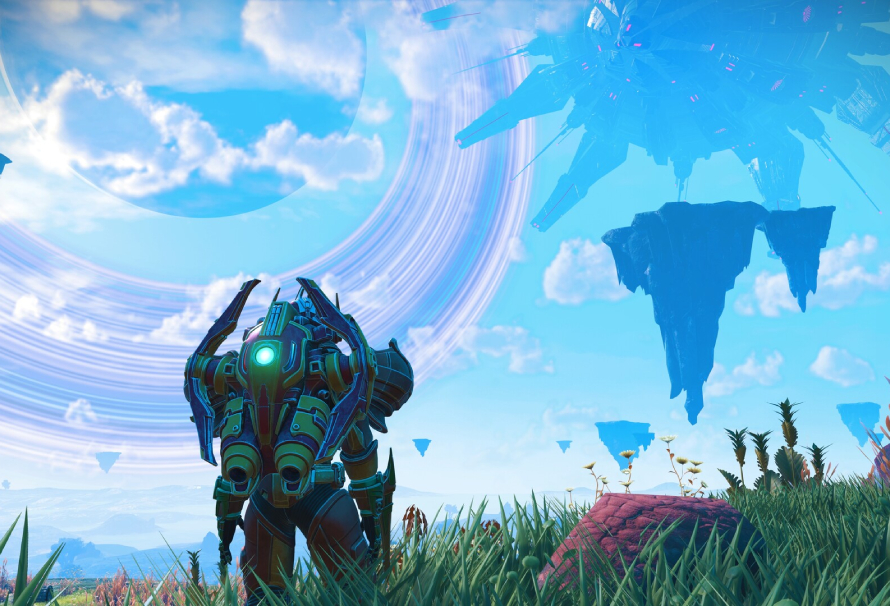
Ten years on, it is hardly a stretch to call Hello Games’ No Man’s Sky one of the best redemption stories the games industry has ever produced. To understand the scale of that achievement, though, we first need to dive face-first into the pool of disappointment that greeted its original launch in August 2016.
Despite getting on a bit in years, I remember the announcement of No Man’s Sky remarkably well. Before its reveal trailer had shown even a second of gameplay, Hello Games was already stressing the scale of its procedural universe: every planet unique, every creature unique and, in the trailer’s most audacious phrase, every atom procedural.
The pitch was irresistible. Here was a boundlessly ambitious open-galaxy sandbox in which players could discover planets and star systems that nobody else might ever find, unless they shared the coordinates, of course.
Its space combat, resource gathering and mission structure owed something to games such as Frontier Developments’ Elite Dangerous, but No Man’s Sky appeared to be chasing a different level of intimacy and detail. Its planets were not presented as barren rocks drifting through space. They seemed alive with flora, fauna, oceans, storms and strange discoveries. Better still, the journey from a fleet battle in orbit to an adventure on the planet below appeared completely seamless, with the promise that friends could share the experience.

It was jaw-dropping, but it was difficult to keep doubt from creeping in. How were the PlayStation 4 and the more modest PCs of the era supposed to support such technical ambition? And how would Hello Games, an independent studio best known for the smaller but hugely enjoyable Joe Danger games, pull it off? The whole project felt like an improbable leap from a team punching far above its weight.
When No Man’s Sky finally arrived in August 2016, it fell dramatically short of the expectations built around it. The most infamous gap concerned multiplayer: players quickly discovered that the shared-universe experience many had anticipated was not there in the form they expected. Other systems felt thinner, less varied or less dynamic than the pre-release demonstrations had suggested.
The result was more than ordinary launch-day disappointment. No Man’s Sky became another reason for players to distrust spectacular reveal trailers that appeared to show far more than the finished game could deliver. For many, it recalled the backlash surrounding the 2013 reveal of Watch Dogs: another gulf between a dazzling first impression and the product people eventually played.
Hello Games found itself in a position no studio would envy. Its initial response was quiet, and the lack of communication only intensified the anger. Then the updates began.

Whatever you make of the studio’s handling of the launch, its long-term answer has been extraordinarily clear. From August 2016 to the game’s tenth anniversary in August 2026, Hello Games has supported No Man’s Sky with a relentless stream of updates, all provided free of charge. A decade of expansions that many publishers might have packaged as premium DLC has cost existing players nothing. Nowt. Zilch. Nada.
These have not simply been collections of bug fixes and balance tweaks designed to mollify a frustrated audience. Hello Games has delivered dozens of substantial releases that have reshaped the game, brought it closer to the vision suggested by those early trailers and, in several respects, pushed far beyond it.
Multiplayer grew into a genuine pillar of the experience. Planetary variety and environmental detail expanded. Fleet combat, base building and exploration gained greater depth. Then came additions that went well beyond the original pitch: full VR support, exocraft, mechs, pets, community expeditions, living ships, settlements, major engine upgrades and much more besides.
The cumulative effect is dizzying. With each major release, Hello Games earned back another measure of goodwill. Steam now lists both the game’s overall reception and its recent reviews as “Very Positive”, a remarkable reversal for a title once synonymous with launch-day backlash.

The game’s reach has grown alongside its feature set. No Man’s Sky began on PlayStation 4 and PC, then expanded to Xbox One, Xbox Series X|S, PlayStation 5, macOS, Nintendo Switch, Nintendo Switch 2, and multiple VR platforms. Those versions are not identical in every respect, but the expansion has brought the game to millions of additional players. Switch 2 even added multiplayer that had been absent from the original Switch release.
That matters. Hello Games not only repaired its relationship with the community it already had; it kept finding new audiences and gave them the benefit of years of accumulated work.
No Man’s Sky may be the industry’s most impressive redemption arc, but it is also a challenge to every studio that launches a game before it is ready. Hello Games has shown that trust can be rebuilt, although there is no quick or comfortable route back.
The broad lesson is straightforward: acknowledge the gap between promise and reality, keep improving the game and let consistent delivery do the talking. Most importantly, the finished experience must eventually justify the patience being asked of players. Communication matters, but communication without meaningful progress is just another promise.

Of course, that is far easier said than done. Supporting a game for ten years demands unusual determination, resources and creative stamina. Not every developer or publisher can make that commitment, and fewer still will do it while giving every major addition to existing players for free.
Hello Games’ next title, Light No Fire, is already carrying the weight of that history. Its release date and platforms remain unconfirmed, and the studio has revealed comparatively little since announcing it. That restraint suggests a team conscious of the dangers of overhyping a project, although only the finished game will show how fully those lessons have carried forward.
Future titles aside, No Man’s Sky deserves to be celebrated for what it has become without forgetting how its story began. Its rocky launch is part of the achievement, not something to airbrush away. Ten years later, Hello Games has transformed one of gaming’s biggest disappointments into one of its most enduring success stories. Here’s to another decade of seemingly boundless ambition.




 Add us to your RSS feed