
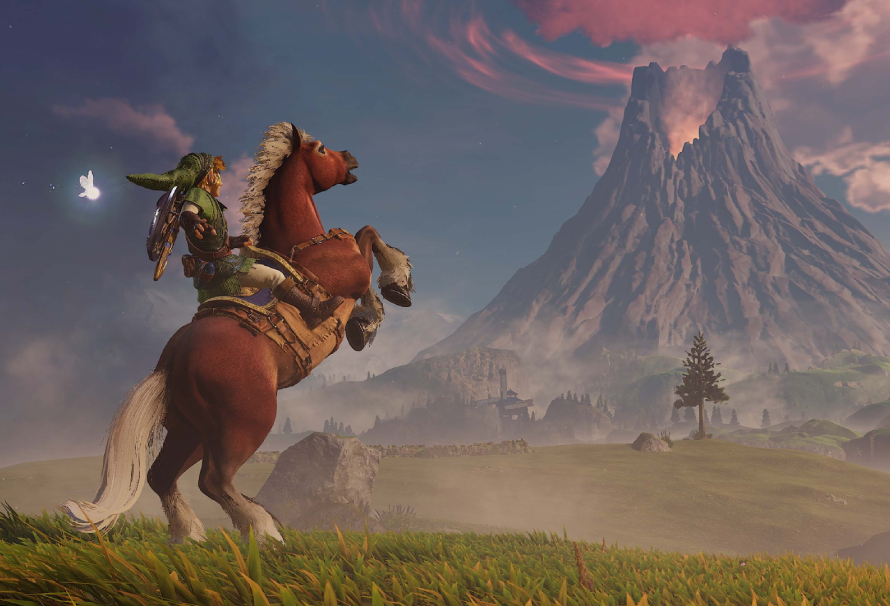
When it launched in 1998, The Legend of Zelda: Ocarina of Time was, and still is, a masterpiece. Nintendo’s first fully 3D take on Hyrule delivered unforgettable characters, a beautifully realised world, and an intoxicating sense of adventure that kept me enraptured for months after release.
Twenty-eight years later, Nintendo has taken on a particularly daunting challenge: remaking one of the most beloved video games of all time. Rather than simply giving the original a visual facelift, the studio appears determined to honour what made Ocarina of Time special while reimagining its presentation, controls and dungeon design for a new generation.
Here’s how Nintendo is striking that delicate balance.
Even today, Ocarina of Time’s visual charm has hardly dimmed. Nevertheless, there is no escaping how heavily the original game was constrained by the Nintendo 64 hardware of its era.
Nintendo could have stopped at creating new assets, increasing the resolution and improving the frame rate. Instead, those upgrades form only the starting point for a far more ambitious remake.
Alongside 4K resolution when docked, a smooth 60 frames per second and VRR support on Nintendo Switch 2, the remake removes the loading screens that once interrupted transitions into building interiors. Players also benefit from full 360-degree camera control, physics-driven reactions in place of canned animations and a real-time day-and-night cycle that extends across the whole of Hyrule.

That freely controllable camera applies throughout the game. Locations such as the Market and Hyrule Castle Town, which previously relied on fixed perspectives, can now be explored from every angle. It is a seemingly straightforward change, but one that should make these familiar spaces feel more open and tangible.
Nintendo has also introduced a host of subtler improvements. The redesigned character models retain the exaggerated eyes and jawlines that reflected Shigeru Miyamoto’s affection for puppet-theatre aesthetics, while adding far more detail and personality. Link’s eyes follow objects and characters around him, while his movements have a more deliberate and natural quality.
The result is an updated visual identity that remains recognisably Ocarina of Time, rather than replacing its distinctive style with something entirely different.
The remake’s controls and traversal systems have received just as much attention as its presentation.
Perhaps the most immediately noticeable change is the addition of a dedicated jump button. In the original game, jumping was entirely context-sensitive. Link would automatically leap when he ran towards the edge of a platform, leaving the player with little direct control over the action. The remake allows players to jump on command. Link can also leap towards climbable surfaces such as vines, ladders and fences, then accelerate his ascent or descent as required.

He can now break into an uninterrupted sprint, too, allowing him to cover greater distances without forcing players to repeatedly roll forwards, as many did in the original. Both Young and Adult Link can also swim faster and turn more sharply, which should make areas such as Lake Hylia and the infamous Water Temple considerably less laborious to navigate.
Inventory management has undergone an equally significant overhaul. A new radial menu and quick-swap system reduce the need to open the main inventory whenever Link needs a different gadget, keeping exploration and combat moving at a steadier pace.
Playing the titular ocarina has also been expanded. Traditional controller inputs remain available, but players can hum or whistle melodies into the Nintendo Switch 2 microphone. The game can even respond to music played on a physical instrument, including the dedicated ocarina accessories. It is the kind of feature that would have seemed almost unthinkable in 1998, yet feels perfectly suited to a remake built around preserving the original game’s musical identity.
From a design perspective, no part of Ocarina of Time appears to have been reconsidered more carefully than its dungeons.
Inside the Great Deku Tree, for example, knocking down a wooden ladder was originally a simple matter of aiming the Fairy Slingshot and firing. In the remake, Link must instead hit an eye switch that activates a physics-driven pulley system, lowering the ladder in a more convincing and interactive fashion.

The Forest Temple has received similarly thoughtful additions. The turnstile used to rotate a cylindrical stone wall now incorporates a new torch-lighting puzzle, adding an extra layer to a familiar challenge. The battle against Meg has also been made more complex. The Poe Sister and her clones have overhauled animations, allowing them to evade attacks and feint more dynamically than they could in the Nintendo 64 original.
Nintendo has also addressed some of the frustrations associated with navigating these spaces. In the original Forest Temple, incorrectly positioning certain stone blocks could force players to backtrack and climb several ladders. The remake introduces a lift in the centre of the temple’s shaft, making it much easier to move between its different levels.
These changes do not fundamentally replace the dungeons players remember. Instead, they build upon the original layouts, smoothing away unnecessary friction while adding new wrinkles for returning players to discover.
Remaking Ocarina of Time was never going to be a simple undertaking. Modernise too little and the result risks feeling dated; change too much and Nintendo could lose the atmosphere, character and sense of discovery that made the original so enduring.
So far, the remake appears to understand that challenge. Its visual overhaul, more responsive controls and reworked dungeons all aim to make Hyrule more inviting without discarding the ideas at the heart of the 1998 classic. If Nintendo can maintain that balance throughout the adventure, this could be more than a polished return to one of gaming’s most celebrated worlds. It could become the definitive way to experience the Hero of Time’s greatest journey.



 Add us to your RSS feed