
There are city builders, and then there’s Corsair Cove.
Limbic Entertainment’s pirate strategy game takes a very different approach to the genre. Yes, the familiar foundations are here. You build a settlement, support its growth, and keep resources flowing. By almost every other measure, though, Corsair Cove swills grog in the general direction of its peers. Then it sets a course all its own.
How so? We’re glad you asked.
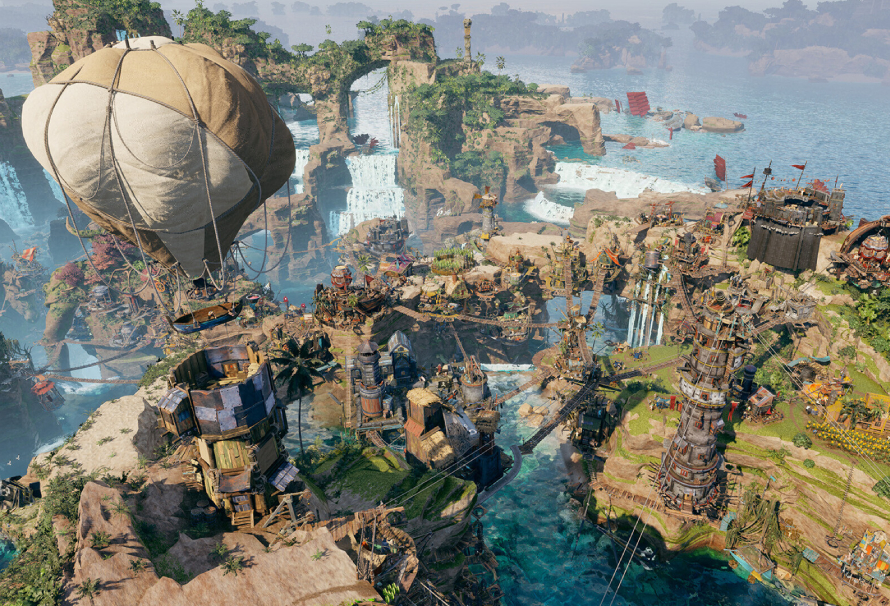
Most city builders are obsessed with spreading your empire across a horizontal game world. Corsair Cove, however, makes that idea walk the plank. Here, construction prioritises verticality above all else.

When you consider the setting, it makes a whole heap of sense. Pirate coves aren’t exactly flat, tidy sandboxes. They are awkward, craggy, dangerous places, full of cliffs, ledges, and hidden corners. That creates plenty of challenges. It also leaves a huge amount of room for innovation.
Corsair Cove lets wannabe Blackbeards build their strongholds across towering cliff faces. Want to bolt housing, a tavern, a cannon foundry, and storage units onto the same wall? Want to connect them all with tactile rope walkways? Corsair Cove lets you do exactly that, and with style.
Corsair Cove’s skyward construction does more than change how your settlement looks. It also has a direct impact on how logistics are conceived and managed.
Because your hive of scum and villainy is built vertically, you’ll need to use ziplines, winches, tilted bridges, and more to move finished goods and raw materials from one point to another. As a result, the logistical challenges feel less like the drab placement of buildings across a flat two-dimensional grid and more like three-dimensional engineering puzzles.

It’s a neat twist on a familiar genre problem. You’re not just asking where a building should go. You’re asking how everything connects, how resources travel, and how your increasingly precarious pirate den keeps functioning as it grows.
Though Corsair Cove’s construction mechanics already set it apart from the genre status quo, developer Limbic Entertainment, best known for Tropico 6, has also put its own stamp on progression.
At the centre of this is a non-linear upgrade system called the Technology Compass. Players can invest points into Wealth, Seafaring, Empire, and Notoriety, with each discipline offering its own boons and progression rewards.
Pouring points into Seafaring, for example, can lead to stronger ship hulls. That makes your vessels hardier in combat, but it also allows your marauding ships to stay out on the great blue for longer, exploring, pillaging, and generally making a nuisance of themselves.

In games such as SimCity or Tropico, players are usually tasked with building and managing a city for a populace that is, by and large, compliant, peaceful, and not falling apart from scurvy.
Corsair Cove makes it clear very early on that the denizens of your settlement are a rowdy, volatile, chaotic bunch who care about little beyond plunder, rum, and maintaining a minimum state of hygiene. If you’re hoping to manage public services, govern tax-paying citizens, or perform some feats of joined-up social care, Corsair Cove probably isn’t the game for you. Unless, of course, you think controlling a bunch of grogged-up pirates somehow counts.
As a result, growing your settlement feels very different from managing more respectable folk in other city builders. You aren’t simply sitting back and watching a passive production model slowly tick up a few resource numbers while your colony grinds towards expansion.
Instead, Corsair Cove pushes players to be outgoing, opportunistic, and aggressive. To sustain your settlement and fund future developments, you’ll need to switch between micromanagement at home and expeditions on the high seas, pillaging, stealing, and snatching whatever isn’t nailed down to make up for the resources you can’t reliably produce yourself.

In case the title didn’t give it away, there’s a whole lotta pirating going on in Corsair Cove. Much of it, somewhat predictably, takes place away from your settlement and out on the high seas.
Alongside building a compelling home for all manner of scallywags, players can recruit captains, assemble an armada, raid forts, track down hidden treasures, and wage war against agents and sailors of the Crown. Further into the game, some of Corsair Cove’s most challenging encounters come from its fearsome catalogue of sea monsters, including mythological nautical beasts such as the Kraken, which should provide a robust scrap for even the most sun-bleached seadog.
It’s also when Corsair Cove leaves its land-based settlement of salty, sozzled rogues behind that Limbic Entertainment’s latest effort puts even more distance between itself and its contemporaries.
Where many city builders either use simple RTS-style systems for combat and events, or avoid combat entirely, Corsair Cove leans in a very different direction by embracing tabletop RPG-style mechanics. In practice, that means card pulls and dice rolls can influence everything from the outcome of a hard-fought tactical battle to the way random island events play out.
All told, this gives Corsair Cove a palpable old-fashioned tabletop charm, while also providing yet another clear point of distinction from its genre stablemates. For strategy fans who like their city-building with a bit more rum, risk, and rope-bridge engineering, Corsair Cove looks well worth keeping on the horizon.




 Add us to your RSS feed