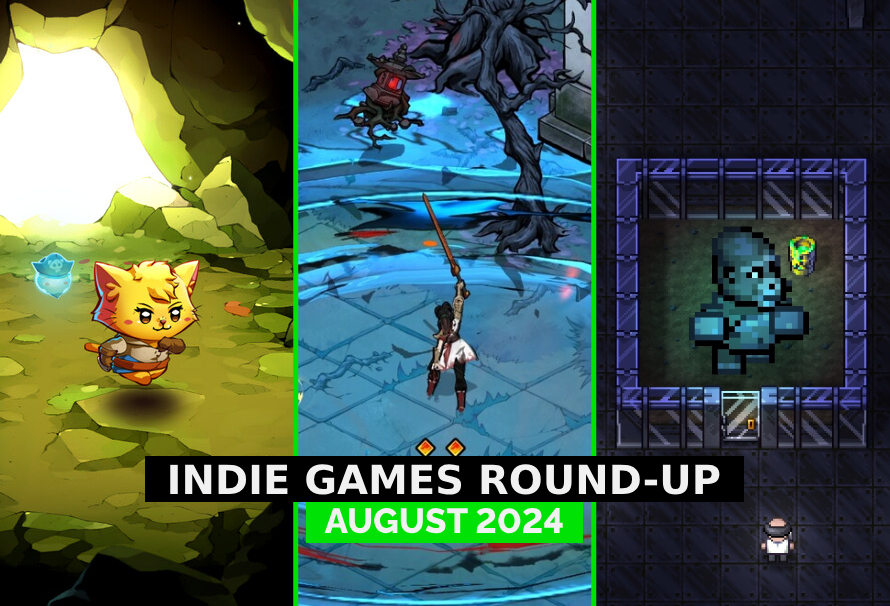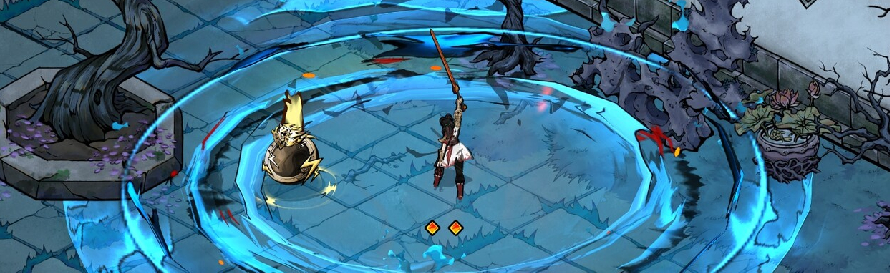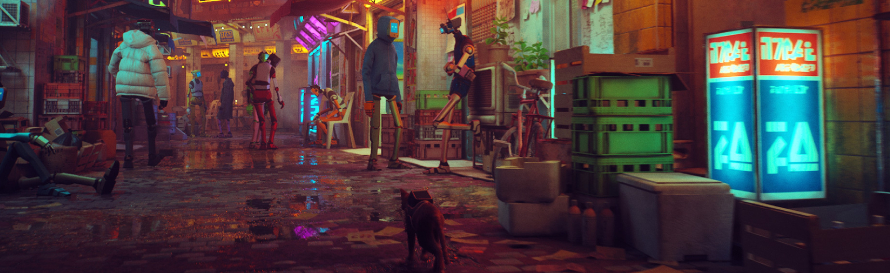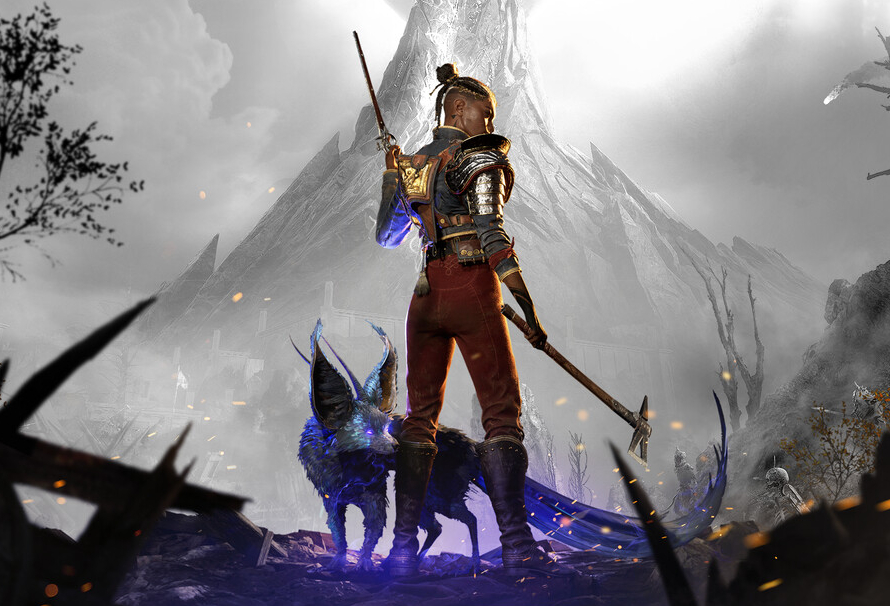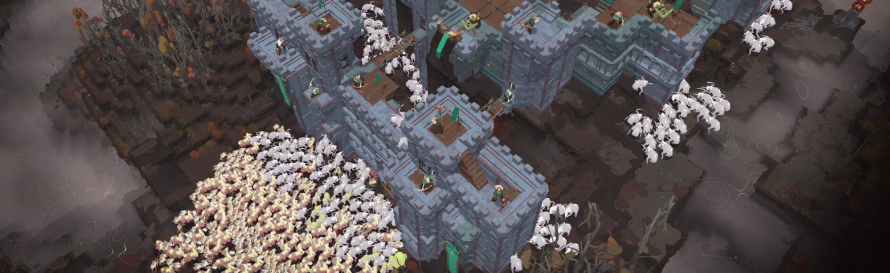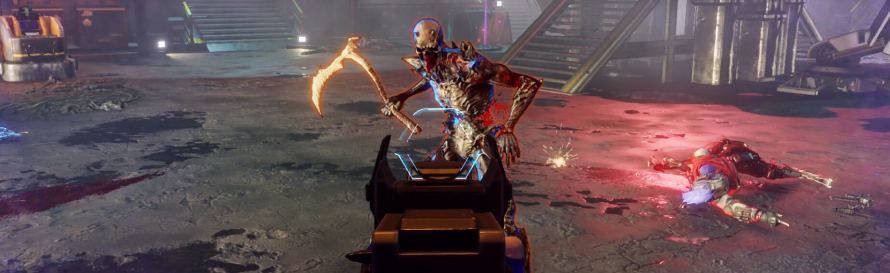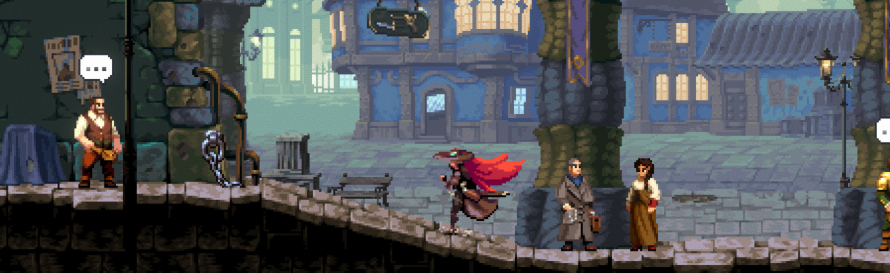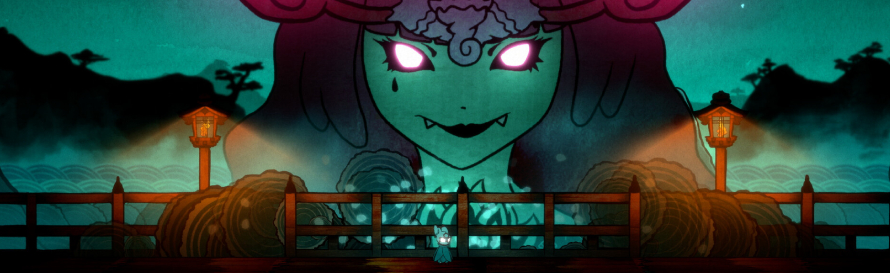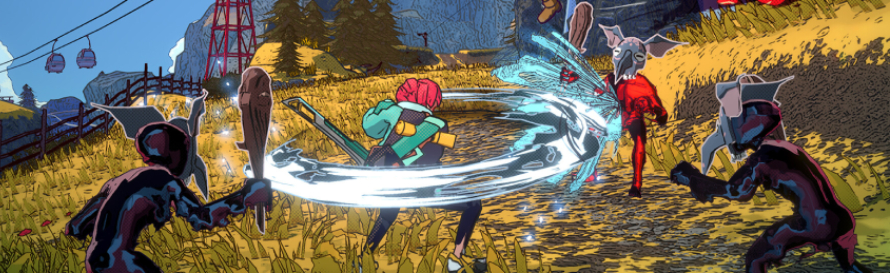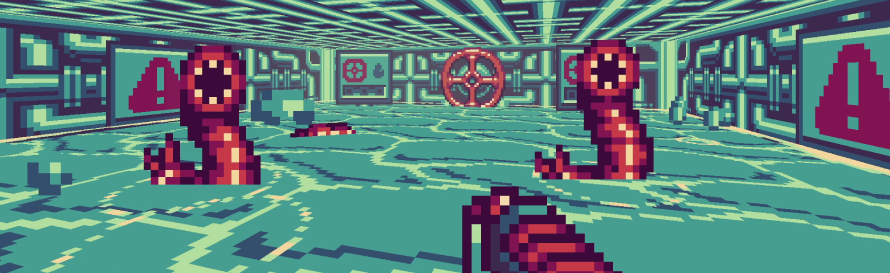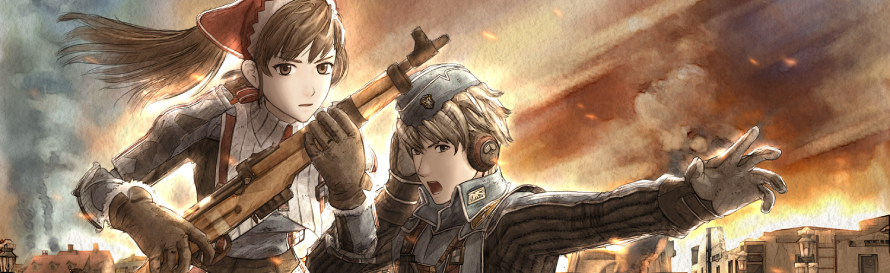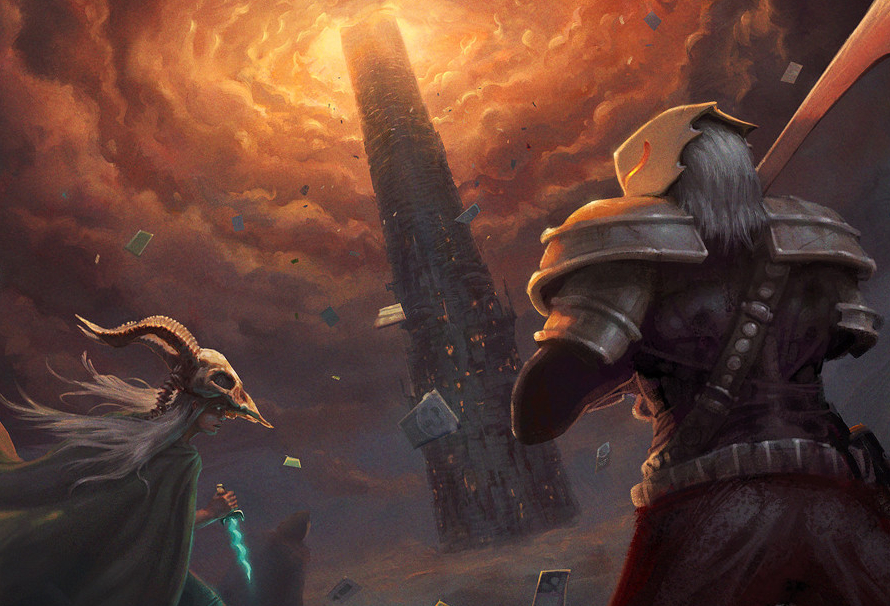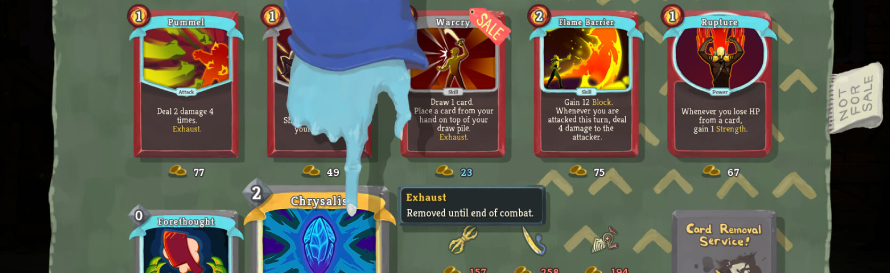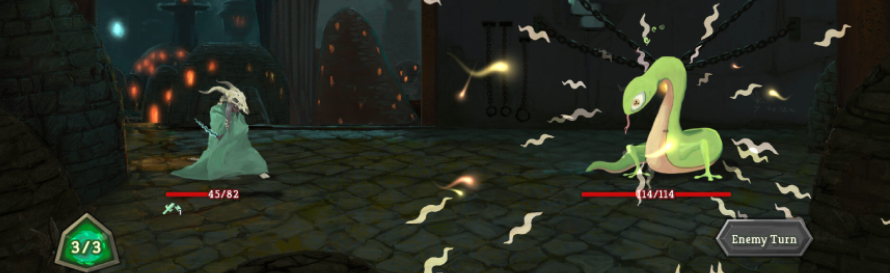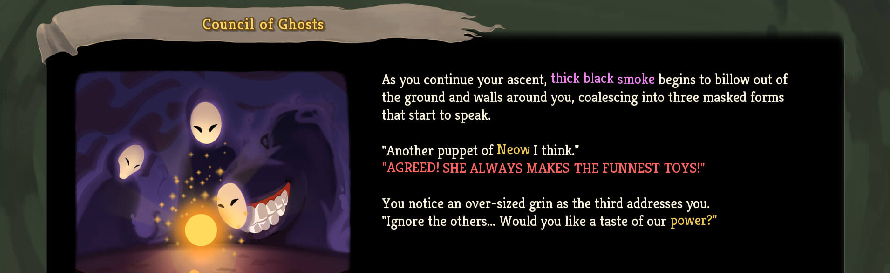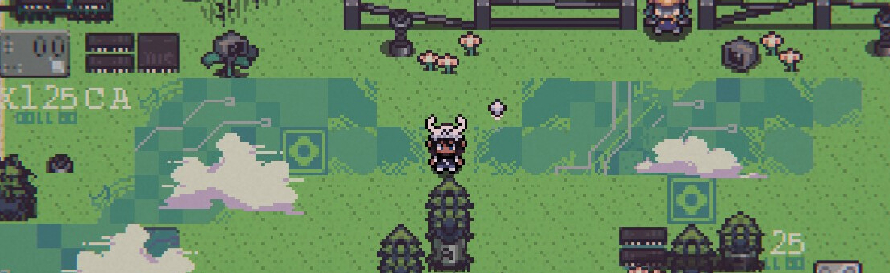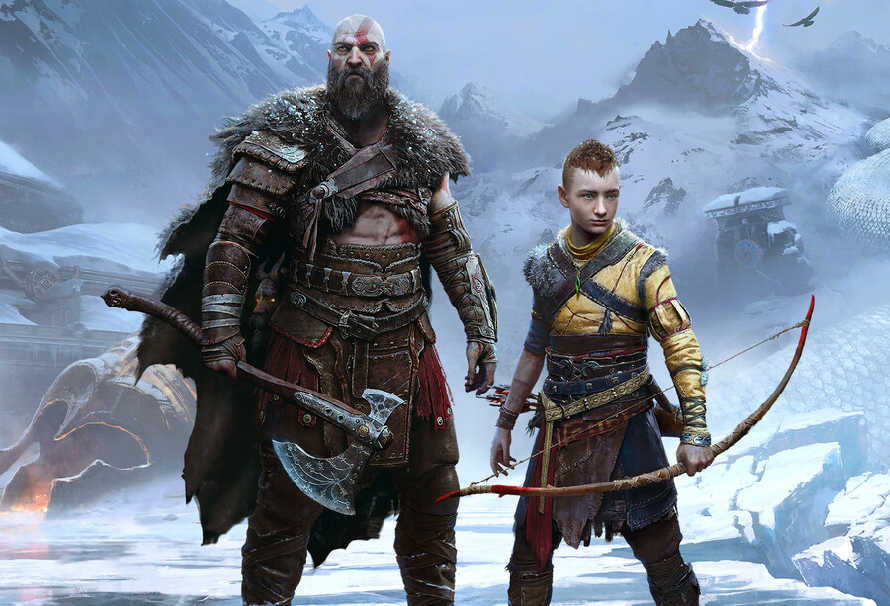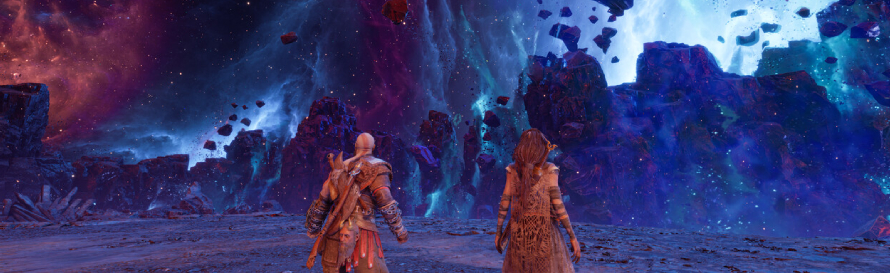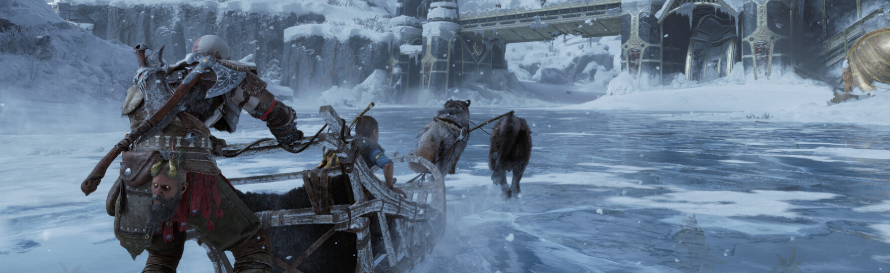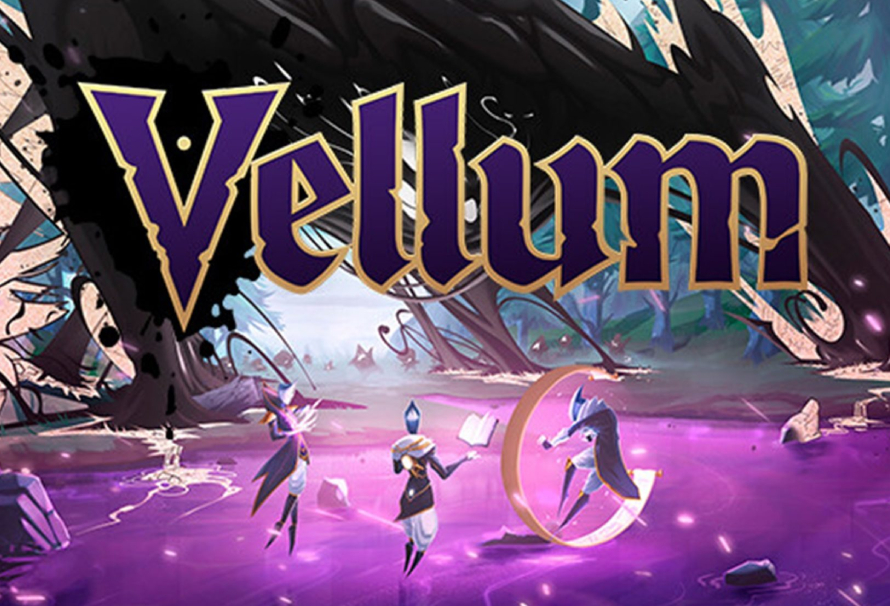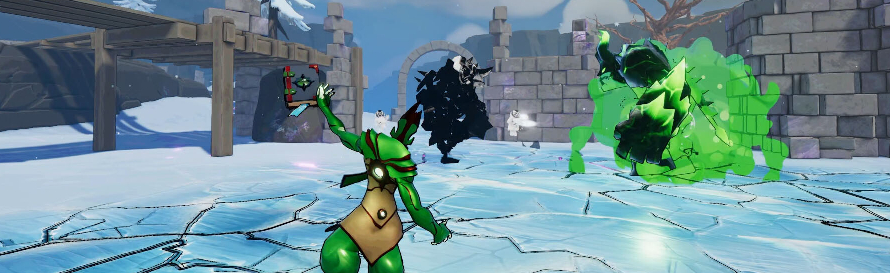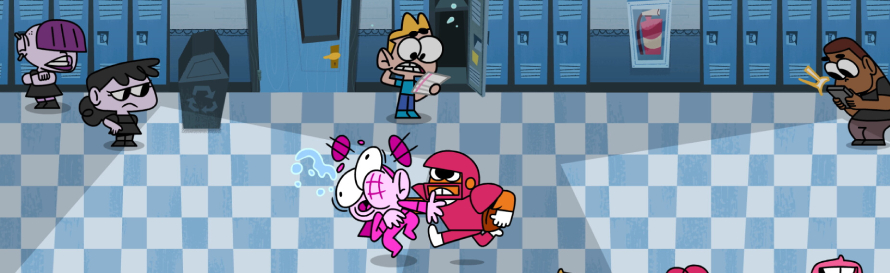
We know there are a lot of roguelikes, but it’s still always worth highlighting the ones that either do something new and exciting or just feel good to play. Vellum manages to do both of those things and on top of that, also looks absolutely fantastic thanks to its inky art style and fountain pen protagonists.
Given its fondness for calligraphical objects, it should come as no surprise that Vellum tasks you with fighting your way through different books. Each book is divided into chapters and each chapter comes with its unique rewards that you can unlock along the way. Some of these will be things like allowing your tome-bound wolf companions to use special attacks, while others are quests you need to complete to unlock new buffs.
You’ve then also got your spell buffs and tweaks too. You start with only one movement, one special, and one standard spell and you can unlock more of these as you progress. Each of these can be changed and upgraded as you complete different levels, or as you overcome specific enemies or find hidden objectives. On top of that, you’ve got signature ink colours to utilise. You begin with a blue one, which is a damage-over-time effect and you can unlock new ones as you progress, like the yellow one that allows for critical hits, or the red one that lets you steal the life of your enemies.
And to build on things even further, you have to choose buffs to bestow on your enemies as you progress. You get to pick your poison and make things harder for yourself or choose the one that’s going to be the least awkward to deal with, adding a lovely layer of strategy into the mix. The systems all wrap around each other to make for a truly exceptional action roguelike. Plus, and this is one of our favourite bits, it’s also co-op!
Vellum is currently available in Early Access, but it’s already changed substantially in the two months since its launch, so we can’t wait to see how it keeps evolving.
Offering up a veritable cornucopia of gaming offerings for players of all stripes and tastes, this year’s Summer Game Fest really did have something for everyone. With such a spread of splendid-looking titles announced and promising existing offerings shown off during this year’s various showcases, we felt we had to compile a list of our favourites. So without further delay, here are some of the best games from Summer Game Fest 2024, Xbox Showcase, Ubisoft Forward and more.
Alan Wake 2 – Night Springs DLC
A continuation to one of 2023’s best games and certainly one of the atmospheric survival horror efforts of the past decade, the Night Springs DLC for Alan Wake 2 has the titular cursed writer scribbling television scripts as a means of escape, only to be drawn yet further still into the living nightmare that has defined his existence. Offering up three episodes that each boast a very different set of themes, not to mention a faster, more action-packed adventure and guest appearances from the protagonists of Quantum Break and Control, Night Springs is shaping up to be a tremendous expansion, to say the least.
Assassin’s Creed Shadows
With just over thirteen minutes of stellar gameplay footage, Assassin’s Creed Shadows deep dive at Ubisoft Forward 2024 reassured me that the series’ long overdue trip to Feudal Japan will be greatly successful. Predictably split into two parts, the Assassin’s Creed Shadows gameplay walkthrough gave us an extended look at the twin protagonists, Yasuke and Naoe, going about their business. As Yasuke, confrontation and brute force are the order of the day, with combat which ranks as the most violent the franchise has ever seen with Yasuke bludgeoning folk to death with a massive spiked club before beheading his target, alongside new armour break systems and varying stance postures to boot. When we switch to Naoe, however, more of the series’ traditional mechanics are on display, emphasising acrobatic traversal, stealth and assassination from the shadows, and the ability to destroy light sources (ala Splinter Cell). Coupled with an overhauled engine that offers some truly striking visuals, Assassin’s Creed Shadows is shaping up to be the best Assassin’s Creed in years.
Call of Duty: Black Ops 6
https://www.youtube.com/watch?v=oyZY_BiTmd8
With Treyarch back at the steering wheel and the relative mediocrity of last year’s Call of Duty: Modern Warfare 3 becoming an increasingly distant memory, Call of Duty: Black Ops 6 reminded us all that the world’s longest-running FPS franchise can still put on a show and give genre fiends much to be excited for. Not only has the emaciated afterthought of a campaign that plagued last year’s effort been replaced by a much more ambitious, full sugar and full fat Call of Duty campaign set in the Gulf War, but improvements have been wrought across the board in traditional multiplayer and round-based Zombies modes too. Elsewhere, the new ‘omnidirectional’ movement system now not only provides players with the ability to turn onto their back from a prone position for greater freedom of aiming but so too can they now leap through the air and turn mid-move, allowing players everywhere to live out their myriad John Woo fantasies unimpeded.
Civilisation VII
Though precious few details were revealed regarding the reveal of Civilisation’s much anticipated seventh entry, just the fact that Civilisation VII merely exists was enough cause for fans and the series faithful to lose their collective minds. Set to launch on PC, Xbox, PlayStation and Nintendo Switch platforms, a full gameplay reveal is expected this August. Until then, stay the course, my friends. Stay the course.
Clair Obscur: Expedition 33
Coming completely out of the blue, the flamboyantly named Clair Obscur: Expedition 33 already looks like one of the best and most polished turn-based RPGs to come along in a hot minute. Coming from French developer Sandfall Interactive, Clair Obscur: Expedition 33 honestly looks like it wouldn’t be out of place in the Final Fantasy universe, with a motley team of companions coming together to thwart a malicious entity known as the Paintress, who can erase time and life with a stroke of her brush, Thanos style. Gorgeous to look at and with a wonderfully sophisticated combat system, Clair Obscur: Expedition 33 will be released on PC, Xbox and PlayStation platforms sometime in 2025. If only time would go a bit faster, eh?
DOOM: The Dark Ages
A face-thumping, gore-smashing and metal-thrumming origin story for DOOM’s central protagonist, DOOM: The Dark Ages takes the Doomslayer into a dark fantasy era as he carves his way through the forces of Hell in a story that establishes the roots of his legendary rage. Being a modern DOOM title, DOOM: The Dark Ages revels in the rapid hyperkinetic and visceral combat that the series has long been known for. New additions to the formula include a throwing shield that can rev up like a chainsaw, a gun that chews up skulls and spits out bone into your enemies and what looks like a massive DOOM mech(!) that can be used to smash your enemies to bits. DOOM: The Dark Ages blasts its way onto PC, Xbox and PlayStation consoles in 2025.
Dragon Age: The Veilguard
Though we must confess that we greatly prefer its previous title (‘Dragon Age: The Veilguard’ doesn’t quite hop off the tongue as readily as ‘Dragon Age Dreadwolf does, but we digress), Dragon Age: The Veilguard nonetheless is shaping up rather wonderfully all the same. With a more vibrant art style, coupled with a cutting-edge technical presentation, Dragon Age: The Veilguard not only brings back heroes from previous games such as Varric and others, but it also introduces players to a whole new cast of companions from which players can choose from as they wage war against the apostate Elven mage, Solas. Dragon Age: The Veilguard will find its way to PC, PlayStation and Xbox platforms almost exactly a decade after its predecessor, Dragon Age: Inquisition. Oh and in case you’re wondering, there are still plenty of romance opportunities to be had. Oh yes.
Gears of War: E-Day
Eschewing a direct sequel to 2019’s Gears 5 (though Microsoft did confirm that the series would eventually continue along the same narrative trajectory), developer The Coalition instead presented onlookers with a glimpse at Gears of War: E-Day, a prequel which explores the first day of the Locust invasion and the first meeting of future alpha bros, Marcus Fenix and Dominic ‘Dom’ Santiago. Perhaps the most technically accomplished game of the whole show, Gears of War: E-Day leverages Epic’s powerful Unreal Engine 5 to stunning effect, creating an in-engine trailer showcasing a brutal one-on-one fight between a Locust Drone and a young Marcus Fenix that really looks like a CG movie. Most interestingly, Gears of War: E-Day would seem to re-establish the relatively humble Locust Drone as a terrifying threat, as the trailer shows our hero routinely getting overpowered and beaten until the very end. With its jaw-dropping visuals, a tear-jerking reunion of Marcus and Dom, coupled with carefully chosen instrumentals from the Mad World song that accompanied the launch of the very first Gears of War, Gears of War: E-Day looked simply incredible. No release window for Gears of War: E-Day has yet been set.
Lego Horizon Adventures
Though perhaps the writing was on the wall for a Lego and Horizon collab before Sony’s June State of Play briefing, few could have guessed it would look quite as splendid as this. A playful isometric, third-person action-adventure overflowing with charm, Lego Horizon Adventures has Aloy tearing through machines, building Lego structures and exuding the sort of freewheeling humour that the Lego games have long prided themselves on. Set to release on PC, Nintendo Switch and PS5 platforms this Holiday season, Lego Horizon Adventures already looks like a marquee Lego title and a great Horizon game in its own right.
Perfect Dark
With rumours of its demise seemingly greatly exaggerated, not only was it a pleasant surprise to see the new Perfect Dark at the Xbox briefing, but so too was it something of a relief to see it in such fine fettle. A compelling mish-mash of traditional FPS shenanigans, Deus Ex-flavoured immersive sim elements and Mirror’s Edge-style acrobatic traversal through a futuristic city, Microsoft’s Perfect Dark reboot is already looking like a handsomely made effort that is on track to bring this oft-forgotten franchise back into the limelight.
Star Wars Outlaws
Looking to one-up its stellar work on last year’s warmly received Avatar: Frontiers of Pandora, Massive Entertainment graced audiences with an extended look at Star Wars Outlaws, its open-world action RPG Star Wars adaptation which takes place between The Empire Strikes Back and Return of the Jedi. A sprawling Star Wars offering, Star Wars Outlaws combines cover shooting, planetside exploration and space combat with a huge overarching non-linear narrative to great effect. Looking better and better every time we see it, Star Wars Outlaws stands a very good chance of being the best Star Wars game in ages. August 30 really can’t come soon enough.
UFO 50
Finally, a personal highlight. Though UFO 50 from Spelunky developer Mossmouth lacks much of the AAA bombast and high-end gloss that can be found in other games mentioned in this list, it more than makes up for it with an overabundance of charm, innovation and good old-fashioned classic gameplay. Essentially a fictitious take on playable documentary collections like the superb Atari 50, UFO 50 presents players with no less than 50 full (not mini) games which were released for fictitious UFO console systems during the 1980s. Encompassing everything from fighting games to classic shoot em’ ups through to dusty RPGs, platformers and more, with many of these titles also boasting multiplayer support, UFO 50 is that rare kaleidoscopic treat that everyone will be able to enjoy when it releases on PC this September.
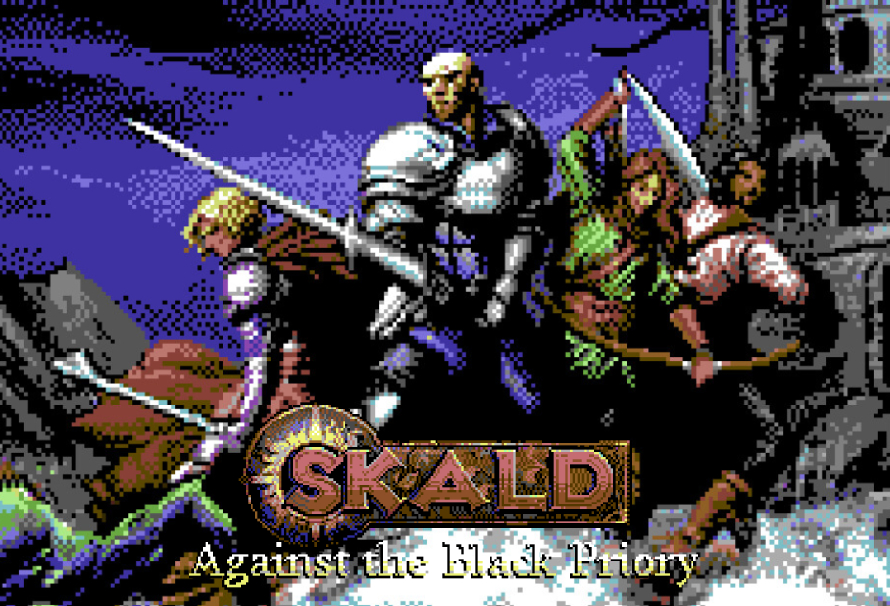
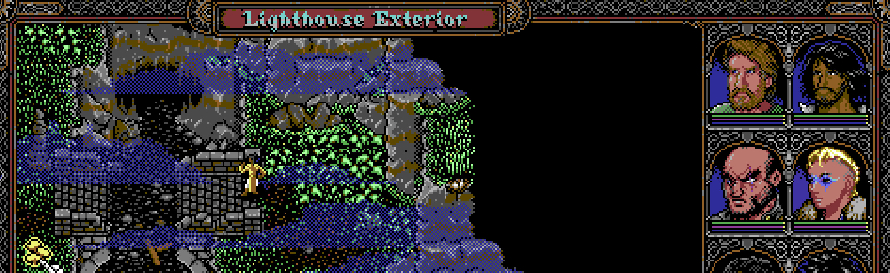
We’re all still reeling from finishing Baldur’s Gate 3 and wandering aimlessly through a digital world now, right? Well, Skald: Against the Black Priory wants to remedy that issue with its 80’s graphical stylings, incredible story, grimdark eldritch horror story, and some absurdly deep RPG mechanics.
Skald has you journeying through a stunning 8-bit world that’s almost always trying to kill you and then dares you to succeed anyway. Aside from your overwhelming tactical genius, you will also have every kind of skill, weapon, and character you can find and bring to your cause. Nothing comes easy in this world, but that just makes earning it all the sweeter.
Fights take place on incredibly detailed grid battlefields and most attacks have an area of influence that means that it’s not just about what attack you use and when, but more importantly where. Your positioning, and keeping your characters working together, are essential especially because you’ll nearly always be outnumbered and outgunned.
Despite the old-school sensibilities of the music and the art, Skald infuses it all with plenty of modern RPG components, including a full inventory system and skill trees. This gives it the feeling of a game that could only exist in 2024, even though its art style suggests otherwise. The mix of classes, status effects, weapons, and armour you need to manage means you can find your own playstyle and master it. That’s not all, it’s also got a cool feature called auto-resolve which is great if you’re finding a specific fight simply too much and can’t find a way out of it, because it just sorts the fight out for you.
So if your longing for a new CRPG – especially on that also taps into that Dungeons & Dragons feeling – but just haven’t found the right one yet, Skald: Against the Black Priory could well be the one to end your woes.
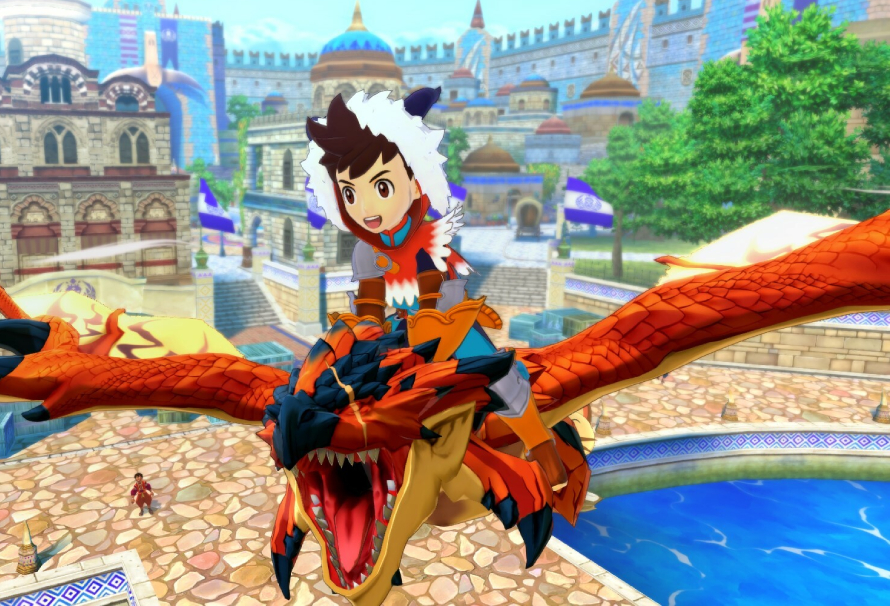
Monster Hunter Stories is finally making its way to more platforms, and that means it’s a great chance to make sure you can get your creature-catching fill by playing other games in the genre too. While there aren’t many games that perfectly match the feel of Monster Hunter Stories – aside from the others in the series – it’s always fun to branch out and try new things, right?
We thought so, so we’ve made sure to compile a list of other games that’ll have you enjoying the wonders of different creatures and monsters for months to come. So, if you’re looking to change things up, or just want to make sure you’ve got plenty to play, then let us fill you in on some options.
Best Games Like Monster Hunter Stories
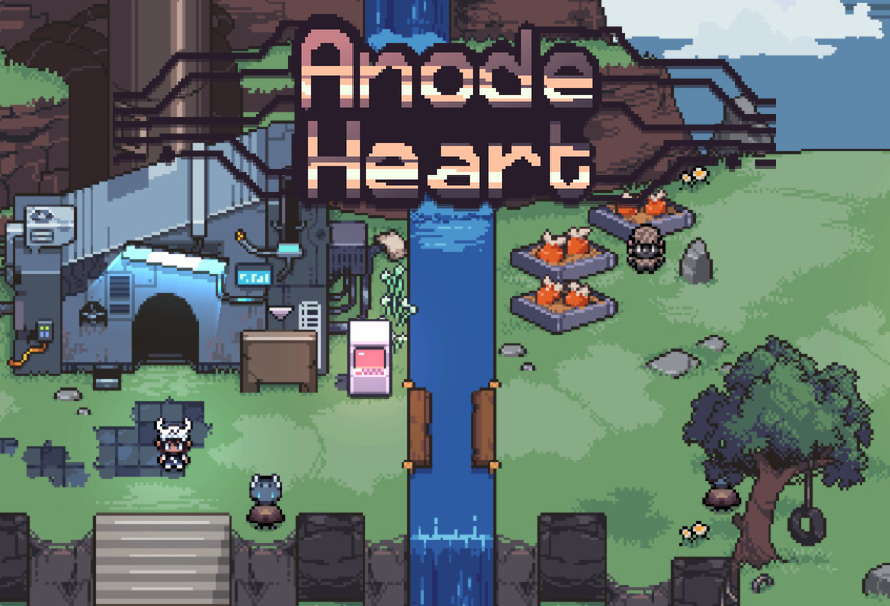
It’s worth noting that there are a lot of games in the creature-collecting genre. Games like Siralim Ultimate, Anode Heart, Coromon, and even Monster Sanctuary are all gems that don’t get enough attention. However, they lack the 3D punch of Monster Hunter Stories, so we’ve not included them in the final list. Do check them out though, because they’re excellent.
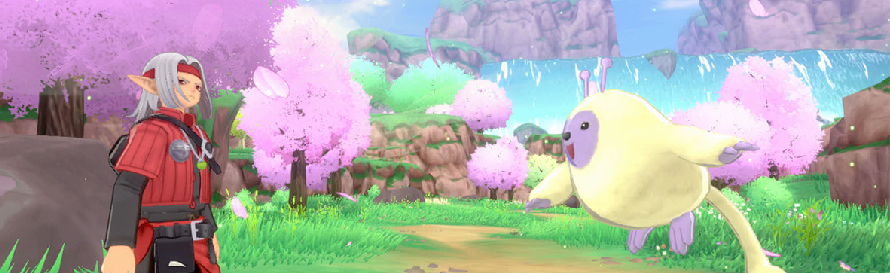
Pokemon Legends: Arceus
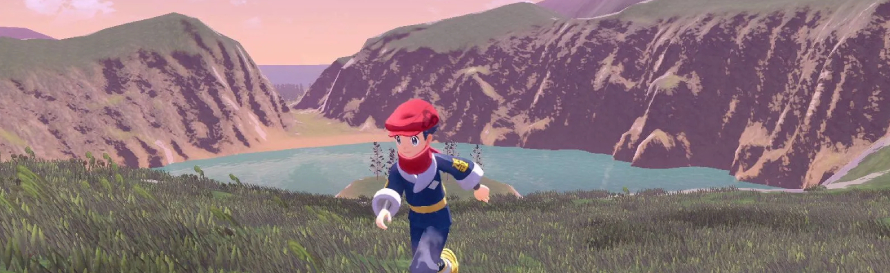
Pokemon Legends: Arceus is quite possibly the best game in the long-running series. It breaks away from the standard formula to make you feel like the world itself is a threat to you, and that you have to live alongside it. You’re not so much asserting your will over a bunch of monsters, although you do that because it’s a Pokemon game, but you’re researching and discovering things. It’s a joy, and while it’s not perfect, it is a lot of fun and a worthy entry on this list.
Digimon Cyber Sleuth: Complete Editon
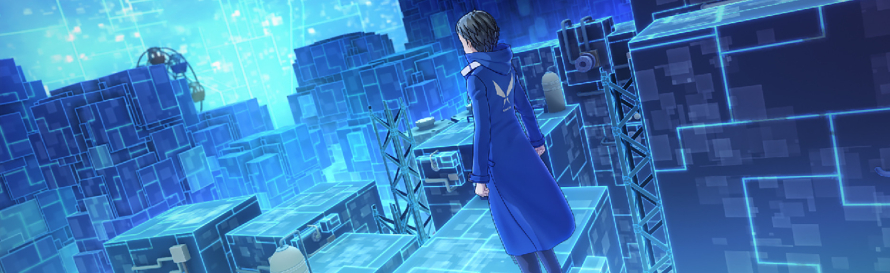
Digimon are indeed “the champions” because few games match the sheer volume of evolutions and devolutions you can go through than the two available here. That’s right, Digimon Cyber Sleuth: Complete Edition has two games in it, and both are exquisite. They’re a little grind-heavy for some people, but if you like trying to create god-level monsters, then this game is it.
WORLD OF FINAL FANTASY™ COMPLETE EDITION
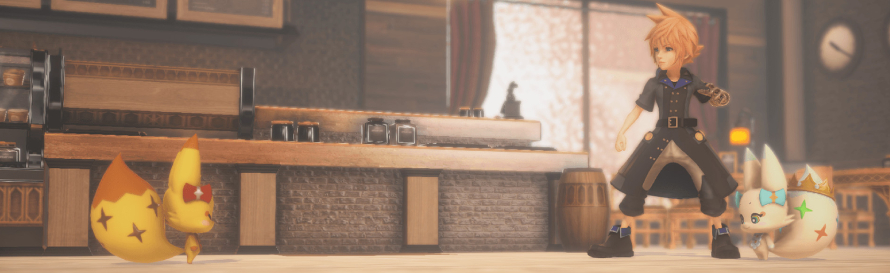
World of Final Fantasy is a seemingly cutesy take on the Final Fantasy series that blends all of the classic monsters into one adorable chibi world. You take control of Ryenn and Lann as they hunt down their past and find out what’s happened to them and their parents. To do so, they gain the power to capture monsters, ride them into battle and master the ability to stack monsters on top of one another to succeed. It’s an absurd concept, but a very well-executed one with a surprisingly dark story.
Palworld
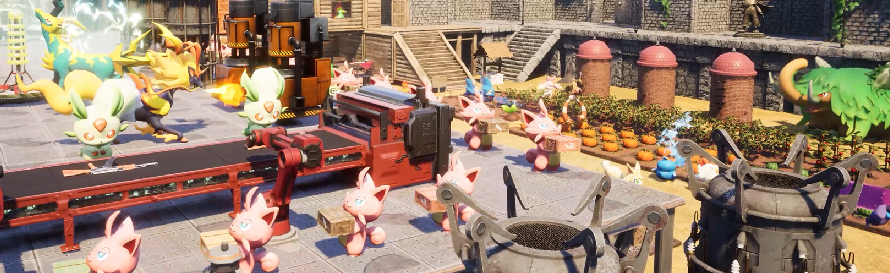
If you expected this to be on the list – then congrats, you were correct. Palworld takes the concept of creature collectors and throws it into a survival game. While you can’t evolve your Pals, you can upgrade them and make themes stronger through battle and training. You also get to make the survival aspects much easier by getting them to farm materials for you, and even fight alongside you with machine guns. Look, we don’t make the games, we just list them.
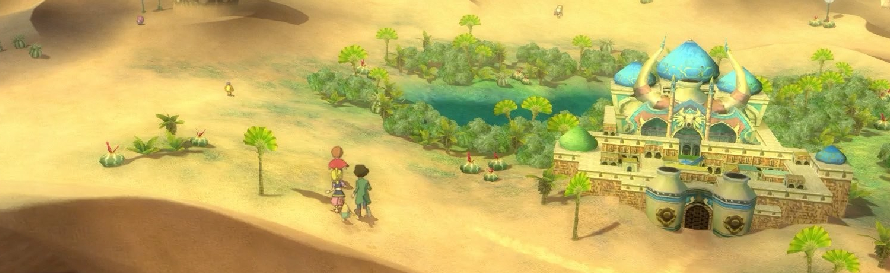
Ni no Kuni Wrath of the White Witch™ Remastered
If you want a heart-warming story that also just so happens to look like a Studio Ghibli film then you’ve probably played Ni No Kuni: Wrath of the White Witch before, but if you somehow haven’t’ then now is as good a time as any. The story follows a young boy called Oliver who’s forced into an adventure through some horrifying events but then finds friendship and immense strength on their journey. It’s cute, it’s fun, and it’s beautiful to behold – which makes it perfect for this list.
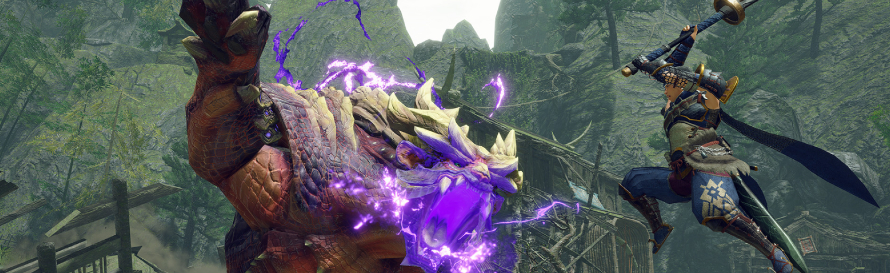
Monster Hunter Rise
Alright, so technically this isn’t really like Monster Hunter Stories, but it is a Monster Hunter game so gets a mention on that basis alone. We were torn between Monster Hunter Rise and Monster Hunter World, but honestly, both are exceptional games, so you can’t really go wrong. So, if you’d rather carve up the monsters you’ve been befriending, then this is the way to do it. Whilst they may be fairly challenging action games they’re so intensely rewarding that we’re sure you will have a blast.
Dragon Quest Monsters: The Dark Prince
The Dragon Quest Monsters series is amazing, and Dragon Quest Monsters: The Dark Prince is the latest entry in it. It follows a half-human half-demon prince as he tries to overcome a horrible curse that means he can’t avenge his mother. To do this, he learns to tame monsters, and the rest is history. Well, it’ll be history once you finish the game anyway. Rather than evolving monsters, you fuse them together in this, and the skill system is a lot of fun to master. Whilst you will have to pull out your Nintendo Switch to enjoy it, it’s definitely worth it!
The best June indie games are coming at us at full speed and will not be deterred, not even by the likes of Destiny 2: The Final Shape nor Elden Ring: Shadows of the Erdtree. If we’re all being honest here, June is a scary month to release a game primarily because of those two Titans, but that doesn’t mean we’re not going to have anything to play.
In fact, we’ve gone ahead and made a list of the coolest-looking indie games releasing in June because not everyone’s going to want to be playing those big titles. If you’re looking for something off the beaten path and something that might just inspire you, then have a read on and get stuck into what June has to offer.
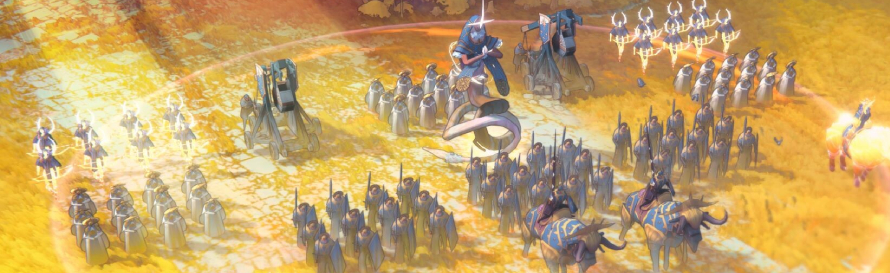
What do you get if you combine 4X strategy and RTS autobattler and throw in a story-rich campaign and a gorgeous Art Nouveau art style? Well, Songs of Silence of course. A hit during last October’s Steam NextFest, you must lead powerful armies against AI and players alike as you seek a new homeland in a world ravaged by an ominous threat known as the Silence. Oh, and it has some pretty awesome musical chops, with the soundtrack composed by Hitoshi Sakimoto.
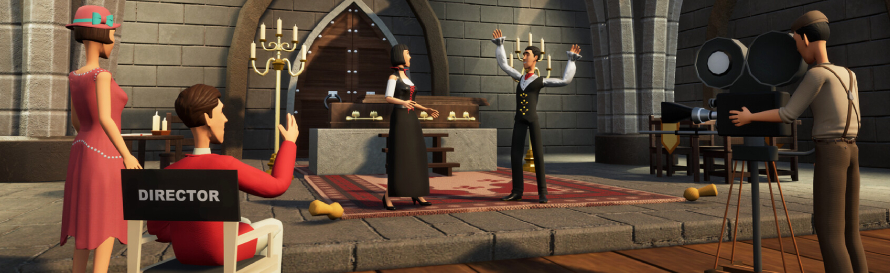
Have you ever wanted to run your own movie studio? Of course you have – after all, how hard can it possibly be to sit at the top of a company founded because mummy and daddy had lots of money? Well, you can live that life out in Blockbuster Inc. which has you making films, managing funds, nurturing your own stars, and even winning awards. Better yet, there’s a demo available for you to test it out before you buy it.
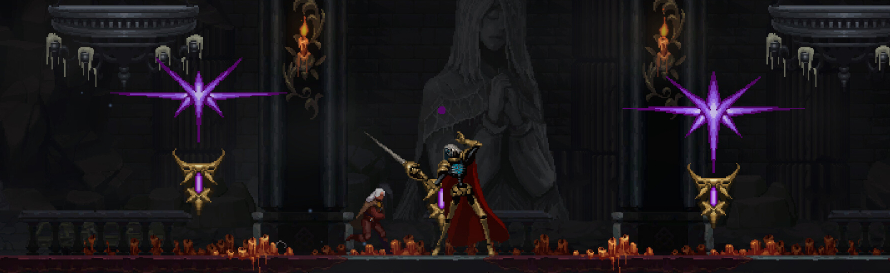
As is customary, there is also a new indie rogue-lite coming to a PC near you soon. Dragon is Dead is an intense action game where you’ll be hacking and slashing your way through countless monsters all to try and defeat Guernian, the leader of the Dark Dragons. Guernian has taken to corrupting the world out of fury, and you have to become a dragon slayer worthy of defeating them. There are loads of skills to mess around with, different characters to try, and all the rage and fury you’d expect from a new entry in the rogue-like genre.
Renowned for their ‘walking simulators’, the latest entry from indie darlings The Chinese Room looks set to see them return to their routes and infuse it with some of their most terrifying horror yet. In Still Wakes The Deep, you are a stranded off-shore oil rig worker who must save their crew from an otherworldly horror that has climbed aboard during a storm. As if the ocean wasn’t already scary enough.
While we’re on the topic of vampires, if you’re more interested in beating them up than being their shoulder to cry on, then check out #BLUD. Inspired by 90s cartoons, and we’re very much talking more along the lines of Courage the Cowardly Dog and Ren & Stimpy here, #BLUD has you fighting off vampires as you make your way through dungeons full of them, and just generally get into a lot of fights. Expect violence, and you won’t be disappointed.
Did you like the narrator from Baldur’s Gate 3? Of course you did because Amelia Tyler is an immense talent. Well, Tyler is playing a character in Thalassa: Edge of the Abyss, which is a brand-new adventure drama game where you need to find out what happened to your former crew, and how they ended up at the bottom of the ocean. This seems like a good choice for those who need a good cry.
Hatch Tales has a bird with a grappling hook in it. Honestly, we might just play it to find out why a bird needs a grappling hook, but the fact that it also looks to be an immensely charming and cute platformer game has certainly piqued our interest too. You’ll need to go through plenty of trials and tribulations to try and save your world, and you’ll need to use every tool at your disposal to succeed – good c-luck!
With the Metroidvania subgenre stretching back decades, it can sometimes feel like the well of innovation is running a little dry at times, with the high points of the genre such as Hollow Knight and Dead Cells seemingly so far and above their peers when it comes to a richness of imagination. Enter Gestalt: Steam & Cinder. Yes, it’s a Metroidvania, but it makes grand use of its Steampunk setting to fashion a new entry in the Metroidvania subgenre that is far more compelling than a great many of its peers have seemed to be in recent times. This is how Gestalt: Steam & Cinder has managed to leverage its Steampunk setting to stand out in an increasingly crowded genre.
A Colourful, Varied Steampunk Dystopia Like No Other
One look at any of the screenshots or assorted media that’s been released for Gestalt: Steam & Cinder will inform both your eyeballs and your brain that this isn’t your regular Steampunk setting. Sure enough, though some of the areas in the game can be found filled with the expected arrangement of bronze-gelded pipes that twist into the sky, such locales are just one in a veritable kaleidoscope of varied locations that Gestalt: Steam & Cinder presents to the player.
Arguably the locale where this diverging bounty of Steampunk colour and style can best be witnessed is in the Steam City of Canaan, an area which both serves as the hub and the centrepiece of Gestalt: Steam & Cinder’s story campaign. A bustling, vibrant metropolis that is much more than just a mess of pipes, cogs and steam outlets, Canaan’s bustling streets and rumour-filled taverns with their 19th-century era stylings and gaslight lamps are an evocative and brightly hued sight that immediately dispel that usual misty and somewhat darker visual stylings that the Steampunk setting usually conjures.
Peel away at the corners of that somewhat unconventional idyll however and a deeper, more complex Steampunk world reveals itself. From the vast mechanical wasteland known as the Scrap Sea, to the vast pools of molten lava of the Fornax furnace and the decaying streets and stalls of the Irkallan Black Market, Gestalt: Steam & Cinder is not lacking in retina-stroking locations that are both varied and compelling to explore.
It all adds up to a Steampunk effort that isn’t just more visually arresting than other titles that have adopted a similar aesthetic, but one which keenly stands out from its peers in the Metroidvania genre. Pointedly, you might reductively think that one Metroidvania is as similar as the next, but in both form and function Gestalt: Steam & Cinder’s Steampunk setting is one that allows it to stand out in both aspects. Oh and before I forget – yes, there are doggo folk in Gestalt: Steam & Cinder and yes, you can absolutely stroke and pet them until your fingers fall off.
Prepare Yourself For A Murder’s Row Of Clanking Machines And Bloodthirsty Foes
Aside from the main protagonist Aletheia and her merry band of allies who all wish to see the Steam City of Canaan free of the evil that encroaches upon it, Gestalt: Steam & Cinder has a more than capable cadre of villains that each reflect a nightmarish vision of the Steampunk setting that serves as its creative touchstone. Numbering among Gestalt: Steam & Cinder’s burgeoning cast of baddies are all manner of horrid foes, including towering automatons with rocket launchers for arms, ferocious mutants and screen-filling arachnid machine constructs to name just a couple. So if you were hoping to get into it with a cast of familiar and relatively dull enemies, Gestalt: Steam & Cinder has you absolutely covered.
Fire And Ruin – An Array Of Deadly Industrialised Weaponry And Armour
Of course, neatly balancing the equation of all those scary folk you’ll be scrapping within Gestalt: Steam & Cinder are the various weapons and combat styles that you’ll have at your disposal. From the start, Aletheia has access to a deadly, razor-sharp sabre (in keeping with the aesthetic, of course) which she can deploy not only in single, powerful strikes but can also chain together a combination of standing combos, juggles and power moves.
Beyond her trusty sabre, Aletheia can also use her trusty hand cannon to finish off foes should she so wish – but its uses extend beyond that of a mere combo ender. By upgrading the weapon, through salvaging parts littered throughout the world and upon fallen enemies, Aletheia can turn her firearm into a devastating weapon with extremely powerful charge plasma attacks that can punish a sizable hole in all but the most robust enemies. In a sense, the combat in Gestalt: Steam & Cinder comes across like a 2D Devil May Cry, with Aletheia making the most of her industrialised melee and firearms-based arsenal to swiftly send her foes to the scrapheap.
Of course, Aletheia’s offensive gear is just one side of the equation, because in Gestalt: Steam & Cinder, our heroine can also loot, equip and upgrade various pieces of armour as well, with each protective piece not only boosting her stats, but can also provide additional buffs and status effects as well. As such, Aletheia is very much a soldier that is emblematic of her industrial age.
Thickly Layered Lore That Enriches The World
Much more than just merely an aesthetic choice, the Steampunk setting of Gestalt: Steam & Cinder also supports a substantially fleshed-out world that has been generously stuffed with its own detailed lore. Put simply, there’s a *lot* going on in the world of Gestalt: Steam & Cinder that you might not necessarily appreciate at first glance.
Both beneath and within the neon-lit walls that serve as the illuminated flora of Canaan, the Comitium are lurking – a conclave of nihilistic overseers that will stop at nothing to change the very nature of existence through their unnatural experiments within the Steam City. With a massing army of Clockwork golems, twisted messes of flesh-metal and many other grotesque fiends at their disposal, Aletheia must stop at nothing to put a stop to the Comitium’s schemes and a big part of that effort are the different characters she’ll meet along the way. From shopkeepers and fellow rebels to forgotten faces from her past, all of them will take Aletheia deeper into both the history and the current plight of Canaan and its surrounding areas.
If all this talk of Steampunk Metroidvania goodness has gotten you excited about what Gestalt: Steam & Cinder is bringing to the genre, be sure to check it out over on the Green Man Gaming store.
Warhammer Skulls, the Ultimate Festival of Warhammer video games comes to the Green Man Gaming store this week with a whole host of discounts alongside new content releasing for several Warhammer titles.
Huge Warhammer fan, actor Rahul Kohli, returned as host for the second year in a row, with the Skulls Showcase kicking off an exciting week of world premieres, announcements and content reveals for Warhammer fans. Alongside the celebration, players can expect huge deals and discounts on the Green Man Gaming Store with up to 90% off savings during the event.
The Warhammer Showcase brought a whole host of surprises with it this year which if you missed you can check out on the Warhammer Twitch channel.
The first of those surprises was the newly announced Warhammer 40,000: Mechanicus 2, the sequel to the much-loved original boasting a unique new feature that will let you play as the ancient Necrons as well as the Adeptus Mechanicus this time around. Much like its predecessor, Mechanicus 2 promises to be a high-intensity turn-based strategy game that’ll have you second-guessing your every move as you try to fight for the Imperium—or against it. Mechanicus 2 is coming soon to the Green Man Gaming store.
There were also not one, but two! Warhammer 40,000: Space Marine 2 trailers with the highly anticipated game showing off a 3-player co-op campaign mode, Operations PVE mode and the return of the beloved online multiplayer in 6v6 Eternal War mode.
The online multiplayer mode will feature up to 6v6-player action, and you can play as Chaos Space Marines or the Adeptus Astartes across six modes, including Annihilation, Seize Ground, and Capture & Control. Alongside that, a cooperative PvE mode allows players to work in teams of up to three Space Marines. If that announcement has got you excited, Space Marine 2 will be coming soon to the Green Man Gaming Store.
The Warhammer Skulls Festival also brought with it a slew of other game updates including the new Forges of Corruption DLC for Warhammer 40,000: Boltgun, the first-ever DLC for Warhammer 40,000: Rogue Trader, which will be titled Void Shadows, and the new Necromantic Horror Faction for Blood Bowl 3. Furthermore, the next Legendary Hero Lord for Total War: Warhammer III was announced, which will be Karanak, the Hound of Vengeance, and will be available for free, coming soon.
Hopefully, that has you all hyped for a great week of Warhammer gaming. You can check out all these games and more on our new Warhammer Franchise page right now! The Warhammer Skulls Sale runs from May 24, until May 30.
After the MultiVersus online beta finished on June 25th 2023, and Warner Bros. Games roundly solid platform fighter MultiVersus was pulled offline, many gamers have been wondering about what developer Player First Games would bring to its much anticipated full-fledged 1.0 launch. To that end and ahead of a full release on May 28th 2024, here are all of the things that have changed since MultiVersus left its open beta stomping grounds.
Rollback Netcode Locked In On Day One
Arguably one of the most significant shiny new things that the MultiVersus 1.0 release brings to the table, rollback netcode stabilises the online player experience in ways that simply were not possible during its beta. Essentially resulting in much smoother online gameplay, thanks to some neat timestamping technology that registers the time of every movement, developer Player First Games has also had to rebuild much of the rollback netcode from scratch in order to fit Multiversus’ often hectic, multi-person matches. The end result is that MultiVersus feels so much smoother and more responsive to play than it ever did at any point during its open beta phase. Fantastic stuff indeed.
Shift To Unreal Engine 5
Continuing the shift to newer and more promising technologies, MultiVersus 1.0 will move over to Epic’s Unreal Engine 5 when it drops in its full release form on May 28, 2024. Providing a sizable uptick in character detail and environment effects that just wasn’t possible prior, the shift to Unreal Engine 5 has also resulted in character models that are larger than they were before, while the scope of blast zones in each stage has been tweaked to account for the bigger combatants. Finally, the camera has also seen something of an upgrade as well, with movement that is much more dynamic than ever before resulting in a presentation that always ensures that the action is clearly in focus.
Refreshed Animations And Sound Effects To Identify Player States
Sitting atop those aforementioned visual improvements, MultiVersus 1.0 also makes some notable strides in terms of its functional aesthetics as well. For a start, brand new animations have been added to MultiVersus which help players to identify whether their characters are in a confirmation or a stun state – both of which are key to skilled play. Elsewhere, a range of new sound effects have also been added to consolidate those new player states, providing MultiVersus combatants with just another avenue of stimulative response in correlation with the on-screen action.
Parrying Is Here To Stay
Another seismic change that has been brought to bear with MultiVersus’ 1.0 version is being able to parry. An entirely new gameplay mechanic that is intended for high-level play, parrying, when done correctly, allows players to recover from an incoming attack quicker than their opponent, providing an ample window to unleash a devastating counterattack in return. Of course, the emphasis here is on being able to ‘successfully’ pull off that parry. With a very small amount of time to pull off the parry, only expert players will be able to make this manoeuvre play off in the heat of battle and so a sizable element of risk and reward is brought into every fight. Do you risk attempting a parry with the chance that you might not be successful and thus take a chunk of damage yourself, or, do you simply just don’t do it – preferring instead to fall back on the other mechanics that MultiVersus offers? All in all, the new parry mechanic is just one example of how MultiVersus has sought to become a more tactical affair since its time in beta.
Say Hello To The Dash Attack
Further afield and neatly complimenting the parry mechanic, MultiVersus now comes packing a shiny new dash attack that all characters can now use. Something of a swiss knife in terms of its potential applications during battle, the dash attack can not only be used to swiftly close the distance between one fighter and another but it can also be leveraged as a means to start or end your combo, depending on when you decide to use it. When paired with the equally new parry mechanic, the dash attack looks set to be an immensely valuable tool in the arsenal of any MultiVersus player going forward.
Updated Character Kits
Given the breadth and depth of MultiVersus’ roster of celebrity scrappers, it should probably come as no surprise that developer Player First Games has used the lengthy downtime that MultiVersus has enjoyed to update its character kits. On day one of MultiVersus’ full release, every single character will be extensively tuned and updated from their closed and open beta forms. Everything from hit placement and hit volume, through to timing and move damage has been tweaked, while all-new abilities supplant moves that from just about every character. Put simply, the scope of the updated character kits now means that even MultiVersus veterans will have to learn their favourite characters all over again – and have a great deal of fun in doing so.
Reworked Armour Mechanics
The substantial reworking exercise that defines MultiVersus full releases expands to the way in which armour is dealt with, too. In addition to a range of specific multi-hit and armour-breaking moves, a range of new limitations and perks have also been introduced, adding yet further sophistication and complexity to MultiVersus’ defensive game.
Casual And Competitive Stage Variants
In addition to the inclusion of new stages, MultiVersus 1.0 will also bring the notion of competitive and casual stage variants, with the former boasting more hazards and traps than usual, while the latter is much plainer by comparison and proves to be better for newer MultiVersus players.
Long Overdue PvE Modes Are On The Way
At long last MutliVerus will receive a selection of PvE modes as part of its leap from beta to full release, though these are expected to arrive a little while after the 1.0 release on May 28, 2024. Regardless, the fact that such modes are even on the cards is fantastic, not least because arguably one of the main dents in MultiVersus armour in beta was that it didn’t possess sufficient modes to keep solo players invested in the game.
Duelists of Eden is an incredible follow-up to one of the coolest deck builder hybrids ever made: One Step From Eden. In One Step From Eden, you fight through loads of awesome enemies and bosses, discover game-changing artefacts, and build a powerful deck as you go. Fights take place in real-time on a grid and have you firing off different spells from your deck and trying to create a build around them as you go.
It’s all very heavily inspired by the Mega Man Battle Network games, and it’s truly sublime. It had multiple endings, plenty of stuff to unlock, and a gameplay loop that could theoretically last you hundreds of hours. Duelist’s of Eden isn’t a sequel to One Step From Eden, it’s a new version of the game, but instead of playing against enemies and bosses, you’re fighting for your life against other players in brutal PvP battles.
In Duelists of Eden, you get to pick your character, build the deck that you want, and then go online to try and beat down other people who’ve done the same. The result is an intensely fast-paced fighting game with a unique feel to it. If you’re a fan of the original roguelike then you’re in for a treat with an entirely new level of challenges, whereas if you’re a fighting game fan who’s looking for something different, Duelists of Eden is exactly that. As with any game, it helps that the graphics are amazing and the sound design is great. It also helps that despite this being a truly exceptional game, it’s somehow less than a fiver.
The bottom line is, you can get this instead of a coffee and still have enough money left over for a chocolate bar or an energy drink to help you try and retain full focus for the battles ahead.
Aiming to be one of the most realistic FPS entries on the market, Gray Zone Warfare is an intense genre offering that combines MMO, PvP and PvE elements to create a sense of scale quite unlike any other tactical shooter on the market as players choose from a selection of PMCs (Private Military Companies) and go to war with one another. Put simply, Gray Zone Warfare is looking to scratch that itch left behind by realistic fare such as Arma 3 and then some.
Be sure to keep this guide in your favourites as we cover everything you need to know about Gray Zone Warfare including the release date, early access details, story details, gameplay details, latest trailer, PC specification details and more.
Gray Zone Warfare Release Date
Gray Zone Warfare was released on PC via Steam in Early Access on April 30, 2024. A full release for Gray Zone Warfare will happen as soon as the Early Access period concludes at which point a release on the Epic Games Store seems likely too. Gray Zone Warfare has not been announced or confirmed for a console release on PlayStation, Xbox or Nintendo platforms as of writing.
Gray Zone Warfare Early Access
Gray Zone Warfare is currently available on PC Early Access via Steam. Though developer Madfinger Games hasn’t put a timeline on when Gray Zone Warfare will leave Early Access, it is quoted as saying “the approximate timeline may span several years, depending on community feedback and the fulfilment of our shared vision” on its Steam page, so we likely have a long time to wait for the Gray Zone Warfare full release. The community can give feedback to Madfinger Games via the official Discord for Gray Zone Warfare. Currently, Gray Zone Warfare’s Early Access provides players with the following features:
A trio of distinct PMC factions supporting up to 48 players in total, with a maximum of 16 players per faction
The expansive 42 km² open world of Lamang, based on a real location, showcasing an unprecedented representation of a jungle
Ruthless AI behaviour, with hundreds of enemies reacting to the player’s moves through the actions and emotions
Complex external and terminal ballistics simulation for a realistic shooting experience
Comprehensive simulation of realistic firearm recoil based on real-world data
An innovative health system that intricately simulates even bodily cavities and damage effects
A network of six unique vendors offering 150 quests in total
Eight highly customizable weapons with over 400 interchangeable parts
A diverse array of over 80 gear items for tactical advantage.
An engaging, interconnected player progression system
Detailed character creation and extensive apparel customization options
Formidable squads, allowing for up to four members for coordinated gameplay
Integrated social features, including Friends, VOIP, and Messenger, for enhanced player interaction
Gray Zone Warfare Special Editions
In addition to the standard version of the game, Gray Zone Warfare boasts no less than three special editions that each come with their own perks, currency and gear. It’s also worth noting that not only will the equipment in each edition be added to your character after every game reset, but so too can players upgrade from one edition to the next with only the difference to pay in order to do so.
Tactical Edition
10×35 size locker for storing items
2×2 size lockbox for storing items that will remain after death
Standard Edition equipment
Tactical Edition equipment
$15,000 of in-game currency
Elite Edition
10×45 size locker for storing items
3×2 size lockbox for storing key items that will remain after death
Standard Edition equipment
Tactical Edition equipment
Elite Edition equipment
$20,000 of in-game currency
Supporter Edition
10×60 size locker for storing items
3×3 size lockbox for storing key items that will remain after death
Standard Edition equipment
Tactical Edition equipment
Elite Edition equipment
Supporter Edition equipment
$25,000 of in-game currency
GZW in-game shirt
GZW in-game gloves
GZW in-game trousers
Special supporter name colour
Exclusive supporter badge
Gray Zone Warfare Story
Taking place on the fictional Southeast Asian island of Lamang, a mysterious incident has resulted in the entire island being almost completely evacuated and placed under quarantine. Keen to not only uncover the enigma behind Lamang’s quarantine protocol, the various PMCs that are vying for control must also pick the island clean and deal with any stragglers left behind by any means necessary.
Gray Zone Warfare Gameplay
Gray Zone Warfare is certainly an FPS that leans very strongly into realism, mirroring earlier efforts such as Arma 3 and Insurgency to name just two. Players are invited to explore and carve their way across the island of Lamang, a mammoth-sized 42 km² landmass filled with jungles, beaches, mountain ranges, abandoned villages, derelict bases and so much more.
Within the boundaries of this persistently online world, players can band together into closely knit squads to take on AI enemies, scour the island for hidden loot caches, take down enemy fortifications or take on one of the many story missions that each shed some light on the reasons why there are stragglers left on Lamang in the first place.
There is also a punishing vector to Gray Zone Warfare’s FPS sensibilities, too. When killed, you will lose all of the gear that you have on your person, while any gear stored in the much smaller secure lock boxes will be safe from looting, if you happen to find yourself six feet under. The upshot of this looting mechanic is that PvP skirmishes in particular carry with them a certain level of anxiety and intensity that you wouldn’t normally experience while forcing the player to prioritise what gear should go into those secure lock boxes and what gear they would potentially be comfortable losing in battle.
Elsewhere, Gray Zone Warfare makes the most of its lean into a more realistic shooter too. Not only has Madfinger Games infused Gray Zone Warfare with a range of fully customisable weapons whereupon the changes and adjustments made to each firearm can affect their ballistic performance on a micro level, but an innovative health system is also in place, where injuries to specific parts of your anatomy can directly affect your performance on the battlefield. Been shot in your right arm? Don’t count on using your primary weapon for a while, for example. With each injury having a bespoke effect on the player, identifying just what those injuries are is a big part of Gray Zone Warfare and one that when taken in tandem with other aspects of its design, makes Madfinger Games’ latest effort feel like the sort of truly gritty shooter many of us have long pined for.
Gray Zone Warfare Content Roadmap
Between now and its eventual final 1.0 release, the current Gray Zone Warfare content roadmap has been outlined by developer Madfinger Games can be glimpsed below.
A complete map featuring all locations and diverse biomes
A hazardous Ground Zero area with end-game enemies and new storylines
Different types of AI behaviours are based on the enemy type, situation, time, or weather condition
Faction-based AI with its own agenda involving quests, patrolling, scavenging, and attacking others
Factions featuring progression systems and diverse reputations
Immersive environmental storytelling featuring mature and engaging plots
Advanced quest system encompassing both main and side storylines
Game-changing, captivating seasonal events
Resource-intensive and survival-focused crafting
Dynamic weather changing the gameplay experience
An accelerated day and night cycle
Unique skills system based on the player’s achievements, not grind
Customizable “hooch” player’s base quarters
Enhanced weapon customizations
Fully customizable gear
Complex trading system for players
Where Can I Watch The Latest Trailer?
The latest trailer for Gray Zone Warfare is available to watch right now and you can catch it above. Heralding the release of Gray Zone Warfare into early access, the latest trailer for Gray Zone Warfare provides a rapid-fire glimpse at everything the game has to offer in its current state, along with a nice and hefty chunk of gameplay to boot.
PC System Requirements
Showcasing a large and densely detailed open world jungle for players to battle around in, as well as a swathe of highly detailed character models to boot, it should come as no surprise that Gray Zone Warfare requires a fairly beefy PC rig to get the most of it. That said, it’s also worth noting that with Gray Zone Warfare essentially at the start of its Early Access journey, the minimum and recommended PC system requirements could very well change between now and the full 1.0 release. You can catch the latest PC system requirements for Gray Zone Warfare below.
With Green Man Gaming turning a golden fourteen years old this month, it can perhaps be a little too easy to forget the years and decades of truly great games that have come and gone in that time. Luckily, we’ve conjured up this feature to remind you just what the best games were of the last fourteen years, so strap in and reacquaint yourself with some of the best games ever made.
Fallout: New Vegas – 2010
Long considered by many to be at the zenith of the recently reinvigorated Fallout franchise, thanks in no small part to the unexpectedly great Amazon series adaptation, Fallout: New Vegas took players to the irradiated Great Southwest and spun out a multi-layered adventure filled with double-crosses, great characters and some of the best writing the series has ever seen. Further cementing its place at the apex of the series is the setting itself, with everywhere from the neon-stained Vegas Strip through to the dusty Mojave Desert providing an evocative backdrop to the delectable open-world RPG shenanigans that Fallout: New Vegas offers at every turn.
Portal 2 – 2011
An eye-opening exercise in achieving the seemingly impossible, Valve’s Portal 2 was somehow not just better than its much-celebrated 2007 Game of the Year-winning predecessor, but it was superior in every way a sequel can be. Portal 2 didn’t just double down on the fiendish, spatial conundrums that made the original such a smash hit, it also introduced a host of new characters to the proceedings along with an endlessly compelling two-player cooperative mode to boot. Even in 2024, it’s not unreasonable to say that Portal 2 still stands tallest in the three-dimensional puzzle-solving genre.
Dishonored – 2012
When Dishonored released in 2012, it not only felt like the heir apparent to the long-dormant Thief series with its super satisfying stealth beats but Arkane’s effort managed to innovate on its own merits too, casting players as a supernatural assassin hellbent on securing his revenge in a world where the arcane and technological often violently clash. Aside from allowing players free rein to tackle its numerous quests and environments however they see fit, Dishonored’s setting strikes something of a match in the imagination too, with the city of Dunwall proving to be an evocative, alternate historical take on the industrialisation of the 19th century where whale blubber and other arcane sources power the city, all the while filth, rats and decay and tear through the city streets.
Grand Theft Auto V – 2013
One of the best-selling video games ever with nearly 200 million(!) copies sold to date, Grand Theft Auto V was (and still very much is) an industry juggernaut the likes of which we probably won’t see again until Grand Theft Auto VI touches down sometime in 2025. Grand Theft Auto V’s success was well-earned however, with extremely high production values underpinning a frankly gargantuan story campaign that had players switching between wannabe criminals Michael, Franklin and Trevor in arguably the most epic single-player campaign Rockstar had devised up until that point. Beyond its sprawling single-player story campaign, Grand Theft Auto V also introduced Grand Theft Auto Online to the masses, a constantly updated open world where players can indulge in all manner of heists, missions, new storylines and traditional PvP modes that is still going unbelievably strong even today.
Alien: Isolation – 2014
Few would dispute that 2014’s Alien Isolation was as perfect a distillation of its big-screen counterpart as you could possibly get. Eschewing the confrontational guts and glory tone of James Cameron’s Aliens, Alien: Isolation instead hews closer to the much more intense dread that crackled through every frame of Ridley Scott’s 1979 Alien. This results in an oppressively claustrophobic and always terrifying survival horror adventure that has you hiding in lockers, crawling around air vents and generally making as little noise as possible as you attempt to evade a roaming xenomorph while learning about Ellen Ripley’s fate after the events of the first movie. Alien: Isolation provides weapons-grade terror that is still as effective today as it was ten years ago.
The Witcher 3: Wild Hunt – 2015
With generous amounts of widespread praise heaped upon it, it was clear that The Witcher 3: Wild Hunt was exactly what the franchise needed to bring it into the big leagues of the RPG genre. Providing players with a beautifully handcrafted world to explore based on Slavic mythology, together with some of the best quests you’ll ever play in an RPG and a cast of characters where an acerbic comeback is never far away, The Witcher 3: Wild Hunt remains one of the best genre efforts you can buy and soars as a blissfully accomplished fantasy RPG that deftly combines darkness, ultraviolence and a grim sense of humour like no other.
Stardew Valley – 2016
Ably maintaining its status as a worldwide phenomenon more than eight years after its initial release, Stardew Valley is a delightful hybrid of farming sim and RPG elements that oozes wholesomeness out of every digital pore. Featuring both single-player and multiplayer activities, Stardew Valley has you finding your place in an idyllic village as you tend to your crops, attend local events, complete quests, discover love and find your place in a welcoming community. Just writing about it gives me the fuzzies.
The Legend of Zelda: Breath of the Wild – 2017
Though Nintendo had seemingly resisted the trappings of the open-world genre for years, it finally succumbed in 2017 when the Japanese industry giant released The Legend of Zelda: Breath of the Wild. Bringing its tentpole adventure franchise kicking and screaming into the open world, Breath of the Wild didn’t just build upon the template, by actually providing a vibrant world that you want to explore thanks to a mixture of overworld dungeons, unique landmarks and secret areas, it masterfully did so in tandem with traditional Legend of Zelda series design. Somehow, those wizards over at Nintendo had fashioned a Zelda game that simultaneously maintained its essence all the while enjoying the sweep and spectacle that open-world design can bring. Truly magic stuff.
Red Dead Redemption 2 – 2018
A prequel to 2011’s Red Dead Redemption, Red Dead Redemption 2 is set in the dying days of the Wild West where the lawlessness and savagery that dominated much of the time are spasming through the stubborn holdouts that are resisting the impending 20th century. Set against this rich socio-historical backdrop, Red Dead Redemption 2 invites players to put on their bandit sash and tear across the Old West in a blistering tale of vengeance and hubris that arguably stands as the best single-player campaign Rockstar Games has ever created.
Sekiro: Shadows Die Twice – 2019
Regarded by many as technically the finest Soulslike game ever made, Sekiro: Shadows Die Twice meaningfully separates itself from other comparable offerings in several key ways. Not only does Sekiro’s action unfold during Japan’s Sengoku period – albeit with a whole heap of mythology chucked in for good measure – it also makes massive, yet nuanced changes to the combat system. Rather than just chipping away at the health bar of your foes, Sekiro is all about striking out at the posture of your enemies, eventually leading to a split-second parry that can result in an instant kill, lending Sekiro a level of intensity and satisfaction that no other Soulslike can match.
The Last of Us Part II – 202
Though The Last of Us Part II doesn’t fiddle too much with the survival horror, combat and crafting systems that defined its predecessor, it does deliver a nihilistic odyssey that is without parallel in its presentation, scope and narrative. Encompassing an absolutely harrowing story that makes the first game look like an episode of Paw Patrol, The Last of Us Part II isn’t just a cautionary tale about the cycle of violence, it also happens to be one of the most atmospheric, satisfying and downright ultraviolet adventures you will ever play.
It Takes Two – 2021
Elevating the bar for local multiplayer gaming into orbit, It Takes Two puts players into the shoes of a squabbling couple who find themselves trapped within their daughter’s hand-made dolls. Locked within the confines of their own home, the two must learn how to work together all over again as they seek to make their escape and break the spell. Embracing a mixture of platforming and puzzle-solving elements, together with a hefty dose of humour and heart-tugging moments, It Takes Two is without a shadow of a doubt the best local multiplayer experience of the last decade and it isn’t even close.
Elden Ring – 2022
Much like The Legend of Zelda: Breath of the Wild before it, Elden Ring was a capitulation of sorts by its developer to embrace open-world design. Naturally given the affection that From Software commands, some players were somewhat anxious about whether or not the Soulslike formula would work in that framework. As it turns out, they needn’t have worried as Elden Ring leans on many of the Soulslike principles that helped to establish the sub-genre in the first place, such as challenging combat, losing collected Runes (think Souls) when killed and more. Yet From Software’s magnum opus takes it even further by giving players a massive realm filled with so many dungeons to conquer, hidden areas to uncover and so much more besides, that the setting of the Lands Between itself is as much a character as the main protagonist themselves.
Baldur’s Gate 3 – 2023
Quite simply, Baldur’s Gate 3 is the entirety of the classic Dungeons & Dragons tabletop experience and all of its trimmings manifested into reality. A true titan of the RPG genre, Baldur’s Gate 3 not only pulled off the unthinkable feat of surpassing the much loved Baldur’s Gate 2 with ease, but it also gave us a resolutely polished, choice-stuffed, utterly massive and downright compelling adventure that doesn’t look like it will be bettered in years if not decades to come. Bravo.
Vampire Survivors is a game so iconic that even though it’s only two-and-a-half years old, it’s still managed to spawn an entire genre. The unique take on horde mode mechanics, item fusions, and meta-progression have all helped the game stay the course, and while other games have built on that in different ways, Vampire Survivors is still a delight. That becomes more true with each DLC, and this time around we get another crossover DLC in the form of Operation Guns.
Operation Guns shoves the world of Contra into Vampire Survivors and brings with it missile launchers, mechs, more aliens, and some really cool boss fights. Aside from the usual mix of new music, new levels, new characters, and loads of new items to mess around with, the biggest new edition comes from the end-of-level boss fights.
There are some spoilers here for the last boss of the first level, so don’t read if you don’t want that spoiled, but just know it’s a very cool moment.
Vampire Survivors has been playing with its own formula for a while. The top-down viewpoint has changed the feel of the game entirely with new multi-layered levels, teleports, and even a character who grows larger in size as they level up.
For example, the first boss you fight in Operation Guns, the first end-of-level boss anyway, is this huge robot that bursts through a door in Neo City. You run up expecting to fight as you always do, and instead, the game shifts the world around you so that you’re no longer top-down, but side-on. You can now run up walls, and the ceiling, and drop down at will, all while fighting this huge boss. It’s just such a clever change and continues to show off how good Vampire Survivors is. If anything else, it also makes me want even more crossover DLCs – but maybe that’s a pipe dream.
Given the success of the recent Fallout TV series on Amazon Prime – it’s very good by the way – there has never been a better time to dive into the world of Fallout. Whether you are a newbie to the series or a veteran returning to the franchise, however, it can be hard to follow exactly where in time and space the events of the game and show take place. That is where this handy little refresher will come in…
When does the Fallout series start?
NOTE: Naturally, there are major spoilers for the entire Fallout franchise ahead, but you can just look at the sub-heads if you are simply looking for the best chronological order to approach things. It’s worth noting, however, that some parts are interwoven, so keep that in mind.
The 1950’s. Alright, so the Fallout series technically starts later than this, and we’ll get to that, but, because it’s essentially set in an alternate version of our world, we should explain that those differences start taking place in the 1950s, with the main split between our realities taking place in 1969. Ironically, that’s when the USA of Fallout also splits, and it becomes 13 commonwealths instead of 50 states.
From here, the technological worlds of robotics and weaponry advance at a pace that far outstrips our own, although, for some reason, no new music ever pops up – weird. This arms race is in preparation for the perceived nuclear war that’s on the horizon – mirroring the Cold War fears in our reality – except in the world of Fallout, it’s more than just a distant fear. Instead, it becomes something that everyone comes to accept as inevitable, leading to the creation of the Vault-Tec Corporation. It’s on their shoulders that the future of humanity rests as they begin their work to build 122 of their nuclear fallout vaults across America to shield citizens from the effects of nuclear war (oh, and to conduct outlandish and highly illegal experiments – which is a running narrative through the games and TV series).
Unsurprisingly, the inevitable eventually does happen with the bombs dropping in 2077 and kicking off the world of Fallout as we know it.
Fallout 4 Prologue – 2077
Despite being the second-most recent Fallout game, Fallout 4 kicks off with the bombs dropping and is the only time in the game you get to experience it directly. The opening has the traditional process of creating your character before you are rushed off to a nearby vault as the sirens blare. You get to experience the bombs falling as you’re going underground, and then you’re put into a cryogenic sleep. Goodnight, Vault Dweller.
This is also a period we flash back to regularly in the Fallout TV show – but we won’t spoil any of that.
Fallout 76 – 2102
The very first vault to open in the world of Fallout, Vault 76 – the setting of Fallout 76 – unleashes its vault dwellers onto the world in 2102 – 25 years after the bombs dropped. As you’ll likely know from the advertising, the game is set in West Virginia, and you’re tasked with helping to start America back on its path to healing following the nuclear apocalypse.
The only MMO in the series, Fallout 76’s main narrative sees everyone – including your character – tasked with the annihilation of the Scorched, a special ‘breed’ of mutant causing havoc in the wasteland and upsetting the planned settling of America. You can approach this however you see fit – as with any good Fallout game – but to do this properly, you’re meant to nuke them into non-existence because, as we have established, nobody in the world of Fallout respects how dangerous these weapons are. Being the most recent entry in the series – and somewhat of a ‘live service – the game is still evolving, but it’s a great way to see the beginnings of classic Fallout factions that we will grow to love/hate, like the Brotherhood of Steel.
Fallout – 2161
Fallout, or Fallout: A Post Nuclear Role Playing Game, is technically the first entry in the series (released back in 1997) and is set 84 years after the bombs dropped. Emerging from Vault 13, you are tasked with finding a new water chip for your vault (a callback and potential plot point referencing this in the TV show) but because video games are rarely simple, you end up facing off against a being called The Master. Unsurprisingly, for a post-apocalyptic world, he wants to mutate humanity using a special virus that turns them into Super Mutants, because of reasons.
Naturally you, as the Vault Dweller, put a stop to this via whatever means suits you and try and return to Vault 13 with the new chip and, if you have done things “right”, a truckload of amazing achievements. In true Fallout style, however, you are refused entry because you are now considered too inspirational – typical.
Fallout Tactics – 2197
Fallout Tactics – or to give it its full name, Fallout Tactics: Brotherhood of Steel – is the first spin-off game in the Fallout series and is dedicated solely to the Brotherhood of Steel. Set in 2197, it tells the story of the creation, development and rise of the iconic faction. Importantly, however, not all of the game’s plot is considered canon, despite some parts being referenced in later games, so if you’re just going for dedicated lore, you can sort of skip it (although it is a very good game).
Fallout 2 – 2241
Fallout 2 is set in 2241, which you’ll note is a fair bit after the original game and even longer since the bombs dropped (164 years, in fact). Interestingly, this game not only tells you what happened to the Vault Dweller from the first game, but you’ll actually get to play as one of their grandkids. You once again have to save your community – there is a theme developing – but rather than a water chip, this time you are seeking out a Garden of Eden Creation Kit (G.E.C.K) – a handy little Vault-Tec creation that allows for terraforming in the wasteland.
Throughout your travels, you’ll come across the New California Republic for the first time, another of Fallout’s iconic main factions, and then upon returning home encounter the Enclave, yet another of the series factions. They are trying to wipe out humanity – well, everyone but them – so you must save your home and the people in it by killing the President of the United States, who is the head of the Enclave. The game ends with you creating a brand-new community made up of Arroyo, the encampment area you grew up in, and Vault 13, where your grandaddy was from.
Fallout 3 – 2258-2277
Fallout 3 kicks off 181 years after the bombs dropped and allows you to experience life in Vault 101 during the prologue. You get to play through the beginning of your character’s life as you go through the first few years of your life, being fathered by Liam Neeson (well, a character voiced by him at least). Things start to go awry when you turn 19, however, and you wake up to find that your father has left Vault 101 and you must head out into the wasteland to find him.
In expected Fallout style, you find out a huge amount on your journey outside the vault, including plenty of secrets – for example, that your parents were actually part of a weird science experiment (who would have thought). You also end up in the middle of a war between the Enclave (them again) and the Brotherhood of Steel (again). Finally, you will have to find another G.E.C.K terraforming unit and defeat the Enclave (again) alongside an enormous robot called Liberty Prime. Look, we didn’t say Fallout wasn’t silly.
Fallout: New Vegas – 2281
Fallout: New Vegas (another spin-off entry in this series, but a full canon one this time) is set 204 years after the bombs dropped and sees you play as a courier who has to try and deliver a package to New Vegas (an area that survived the armageddon relative unscathed). As should be expected in a Fallout game by now, your journey doesn’t exactly go to plan, and you end up stuck between the New California Rebuplic and a new faction called Caesar’s Legion. This just keeps happening, doesn’t it?
Roundly regarded as one of the best games in the series, in New Vegas everything has an impact on the area in which the game is set and its six add-ons each show off a new area and add a new adventure for your courier. Importantly, there are actually four potential endings in Fallout: New Vegas based on who you decide to side with, so technically this could be considered another fracture to the timeline, but it’s localised for now.
Fallout 4 – 2287
We are post-prologue in the world of Fallout 4 now and a massive 210 years after the bombs dropped (and the setting of the game’s prologue). Whilst in cryosleep you accidentally see your wife murdered and your child stolen – something you look to avenge immediately upon waking up in Vault 111. Discovering you are the Sole Survivor of the vault, and seeking out your missing son, you head out once more into the wasteland where you will once again encounter many of the iconic factions as well as something new, Synths.
The long and short of all of this is that you’re not fully aware of how long it’s been since you witnessed your son’s abduction – a common issue with cryosleep – and it turns out that your son is now an old man who’s in the last few years of his life. In what is probably the weirdest nepotism hire, he wants you to continue the work he has started. The only problem is that the organization he created, the Institute, is all kinds of evil, so, unless you choose to join him, the ending actually has you destroying it by blowing up a nuclear reactor. Once again, when will they learn?
Fallout TV Show – 2296
And finally, we reach the Fallout TV Show itself – the furthest point in Fallout lore so far and an impressive 219 years after the bombs dropped. We’re not going to go into spoilers for what happens here but as mentioned at the top of this article, it’s worth noting that some elements of the series are set before all of the games. Go and watch it on Amazon Prime to find out more about Vault 33 and the main protagonist of the show, Lucy MacLean.
The best games like Men of War II will let you flex your strategic, RTS and WW2 military-themed muscles whilst you wait for all of them to be flexed with one handy Men of War branded package when it finally arrives on May 15th. As you would expect, Men of War II, like its previous entries, is a real-time strategy game set in World War 2, which is an already fairly well-populated gaming niche – making it ideal for list-making purposes.
Best Games Like Men of War II
Men of War II is filled with not only the big decisions you’d expect but also thousands of tiny ones as you make your way through the intense narrative offered by the game’s story-driven campaigns. Or, if you are more action-inclined, you can just flex your wrinkly brain in the skirmish modes against AI opponents, or real-world ones via multiplayer. Thanks to all of this, there are some really good options to include in this list of the best games like Men of War 2 – so let’s get into them.
Company of Heroes 2
First up we’ve got Company of Heroes 2. Although getting on a bit now, having released in 2013, Company of Heroes 2 is still substantially better than the more recent Company of Heroes 3, so it’s the best of the bunch when it comes to the Company of Heroes series. It not only sits in the RTS genre but even takes place in World War 2 as well. That means you’ll get a very similar experience here, albeit with a slightly different focus in terms of the individual stories, and also the way the game changes and grows as you get further in. It’s a great game, and it holds up very well.
Steel Division 2
Steel Division 2 is another RTS set in World War 2, and it features 1:1 scale army management, and turn-based elements too. It’s a little more granular and evolved than we’re expecting Man of War II to be, but that’s not a slight on either game. Steel Division 2 is also more about vehicles than anything else, and if you’re a tank or plane buff, then you’ll enjoy getting to look at the models in the game, along with actually getting to play as the vehicles too.
Manor Lords
Yes, we are well aware that Manor Lords isn’t set in World War 2. It is, however, really good, and if you’re looking forward to the strategic planning of something like Men of War II, then it’ll hit a very similar part of your brain. Manor Lords is a medieval strategy game with a few additional layers such as city building and economic management. You take control of a medieval lord and have to guide your people through good and bad times, big old fights, and even the seasons themselves. It’s exquisite, so don’t miss it.
Age of Empires 4
Another one that’s not technically World War 2, but it is sort of all of time forever, so we’re counting it. Age of Empires 4 is an absolute masterclass of the real-time strategy genre and lets you take your chosen leader from the dawn of humankind all the way into the future, with you getting to guide them through every great advancement and more. It’s truly incredible, and if you want to be able to enjoy not only the guns of different World Wars but also things like bows and arrows and even the space race, then no game does it better than Age of Empires 4.
Hell Let Loose
Finally, we come to Hell Let Loose. Hell Let Loose isn’t a strategy game at all, instead, it’s an intensely punishing WW2 set first-person shooter. The fast-paced battles have you facing off in firefights with up to 100 players who can not only run around on foot but also jump into different vehicles or even hop into some artillery. Whilst primarily an intense shooter, it does have a cool RTS meta-game mode that’ll still let you flex your more strategic muscles, as well as the core FPS gameplay that’ll let you play with your reactions. It’s a great game, and if you want a slight curveball option to Men of War II, this could just be it.
Given its incredibly well-received Steam Early Access release, Manor Lords is likely a game you’ve heard of by now. It’s a city-builder and strategy game hybrid where you play your role as the lord of a small domain and guide your people through their impending struggles. That means you’ve got to keep everyone fed and housed, but also keep them safe from any battles that might head their way.
It’s filled with an unending rain of decisions for you to make to keep everything in balance, and there’s a joy to be found in the way it simplifies some of the more intricate building choices you can make that are often more complex in other games in the genre. It’s a lot of information and things to juggle if you’re new to the genre, and it can feel a little bit overwhelming at first, but if you stick to it you’ll find an incredibly unique game, and one that’s an awful lot of fun.
Since its hugely successful Steam Next Fest demo there have been a range of comparisons cropping up, from the likes of Medieval Dynasty to Banish and Total War (the developer has tried to calm comparison to the latter). Now we have had our hands on it, we would say it feels akin to Frostpunk, where you’re jumping between different mindsets to keep everything working smoothly, but you’re never quite as in peril as you are in that game’s brutal post-apocalyptic world. Oh, and it’s got a pretty cool first-person mode that enables you to wander around your little fiefdom.
Manor Lords has been developed by a single person over the last seven years, and because it’s in Early Access, it’s going to continue to evolve and grow over the coming months and years as well. As it stands, it’s not a perfect representation of the genre, but it is a huge amount of fun to play. The battles are currently a little simpler than many people will like, but the city-building side of things feels fairly well-realised already.
If you’re someone who loves a bit of medieval strategy, then Manor Lords is a must-play, but whether you decide to do that now and grow alongside it, or just wait for the full release, is up to you.
The best May indie games are the perfect way to ease into the upcoming warmer months. Well, as perfect as “not being a swimming pool that’s somehow free” can manage. There are, as ever, a lot of cool-looking games heading our way in May, and if you’re looking for something that’s a little bit off the beaten path, then you’ll do very well to check some of them out.
We’ve made a list of some of the highlights from the month so that you can keep your beady, or non-beady, eyes peeled for them. Whether you’re an action person, someone who likes games to be a bit more thoughtful, or basically any other kind of gamer, there’ll be something for you here.
Sometimes zombies are good. Well, maybe not good, but they make for some good games. Undead Inc lets you establish your own branch of the Endswell Medical Corporation, where you’ll have to build, budget, and manage your lab as you look into fantastic new medical treatments and the odd bioweapon. Are you the baddies? Maybe, but it looks like fun.
Heading Out takes some cues from the Sin City style of visuals, meaning you’ll only ever see yellows, reds, and blues here and there as you drive across the USA in this road movie-inspired racing game. You start each run by answering questions about who you are and then get to play out your character for as long as you can, trying to avoid the law along the way.
If you like vampires and base building, and statistically speaking that’s a surprisingly large crossover of people, then you’ll love V Rising. Having been in Early Access for nearly two years it officially launches on May 8th with an official Castlevania crossover in tow. It has you playing as a vampire trying to survive by feeding on everything around you, enthralling people, and taking out vampire hunters. It’s great fun, and especially good with friends.
If you miss the olden days of PS1 horror, then Crow Country is basically made for you. It’s a survival horror game where you investigate a very creepy and very closed-themed park called Crow Country, in a lovely retro graphic style. It seems like a terrible idea, but hey, if people didn’t make silly decisions, we’d never have any stories to enjoy or games to play. Also, there’s a demo available.
Ingenious puzzles – check. Handcrafted environments – check. Unique art style – check. Paper Trail ticks a lot of the boxes we look for in a gorgeous indie puzzler. You must aid Paige (get it) on her first journey outside of the home by literally folding pages (or twisting, rotating, contorting and more) to help her complete puzzles and connect the world. It’s truly a novel idea…
Next on our list is another horror game, because May deserves to be unsettling, apparently. Harvest Hunt, which also has a demo, is a roguelike survival horror game where you play as a Warden who has to try to protect a village from a bevvy of monsters that’d have even the most hardened protagonist crying in a corner. It sounds great but make sure you play it with a comforting cuddly toy nearby.
Another game, another demo. Zet Zillions is a story-driven roguelike where you have to beat up planets. Look, it’s not about being serious, it’s about being cool, and frankly, Zet Zillions has that all locked up. You’ll need to mix and match cards to create new abilities and combos, and try and survive as long as you can in this weird and messed up version of the universe.
Finally, we’ve got a game that’s coming out for free. Previously known as Bloodborne Kart, Nightmare Kart is a PS1-style kart racing game featuring all sorts of nods to FromSoftware’s gothic horror masterpiece. It looks like some of the most fun you can have on four wheels and we’re incredibly excited to take it out for a spin.
Certainly one of the most eagerly anticipated sequels ever and described as the ‘true sequel’ to the long-running Homeworld franchise, Homeworld 3 takes the intergalactic, galaxy-spanning RTS beats that the series has long been known for and builds upon them in earnest, resulting in what is shaping up to be potentially one of the most compelling and polished genre entries to come along in quite some time.
Be sure to keep this guide in your favourites as we cover everything you need to know about Homeworld 3 including the release date, early access details, story details, gameplay details, latest trailer, PC specification details and more.
Homeworld 3 Release Date
Homeworld 3 is set to receive a full release on PC via Steam and the Epic Games Store on May 13, 2024. Homeworld 3 has not been announced or confirmed for a console release on PlayStation, Xbox or Nintendo platforms as of this writing.
Homeworld 3 Early Access & Pre-Order Bonus
Like most recent AAA releases, Homeworld 3 will be offering an early access period to customers that will begin on May 10, 2024. It will be available to those players who stump up the necessary cash for the Homeworld 3 Fleet Command Edition, as it is included as a compelling perk that’s exclusive to that version of the game.
Regardless of whichever edition of Homeworld 3 you happen to pre-order, all players will gain access to the neat Kushan Carrier War Games Skin as part of a free pre-order bonus offer.
Homeworld 3 Special Editions
There are two Homeworld 3 special editions for PC, the Deluxe and Fleet Command Editions, that can be purchased and as one might expect, there are varying amounts of goodies in each that will do their utmost to convince you to part with more of your hard-earned, real-life credits. Here’s the list of the good stuff that comes with each edition:
Homeworld 3 Deluxe Edition
Base game
Year one content pass
Homeworld 3 Fleet Command Edition
Base game
Year one content pass
Digital soundtrack
Exclusive ship decals
Exclusive profile banners
Exclusive multiplayer name colour
Exclusive engine trail colour
Play 72 hours early
Homeworld 3 Story
Unfolding after the events chronicled in the previous Homeworld games (you can catch up on the story with our handy digest, here), Homeworld 3 begins after Karan S’Jet and her forces have secured a definitive victory over the Vaygr, allowing her to open up the much-needed hyperspace gate network to facilitate trading and prosperity to spread throughout the galaxy. This new age of fortune and peace, known as the “Age of S’jet”, has come to an end however after Karan mysteriously disappears and a new enemy known as the “The Anomaly” begins to tear its way throughout the galaxy, snuffing out any sentient life that it comes across. With one hundred years now passed since her disappearance, Imogen S’jet, the successor of Karan, takes a fleet of her own and ventures out into the perilous cosmic seas in a bid to discover what happened to Karan and to finally rid the galaxy of the Anomaly once and for all.
Homeworld 3 Gameplay
Much like the previous two entries in the series, Homeworld 3 once more leans into its 3D RTS trappings. Once again, the overall objective is to shepherd a fleet of ships through Homeworld 3’s extensive campaign, completing primary and secondary objectives as you progress through the story. As before, the destruction of enemy units and the security of your own will win the day as you leverage smaller fighters and bombers to wreak havoc on enemy ships while larger destroyers and frigates provide both covering fire and support functions from the rear. New to the series however are gargantuan space husks that can be used as a means of cover for smaller craft to get closer to their target, thus introducing an additional, almost cover-shooter-like element to the mix. Put simply, Homeworld 3 is more Homeworld with knobs on and that’s hardly a bad thing is it?
Homeworld 3 Multiplayer Modes
For those who wish to venture into Homeworld 3 with or against others, the series threequel has them more than covered. First off, Homeworld 3 boasts a range of AI skirmish scenarios which can be used as a practice ground before you shoot off and take part in a range of frenetic free-for-all, team battles or 1v1 matches with human opponents. Where Homeworld 3 brings something truly new to the proceedings, however, is in the new War Games co-op mode (which has nothing to do with WWE NXT or William Regal – I promise).
War Games is a three-player co-op game mode which takes place after the events chronicled in Homeworld 3’s story campaign. In War Games, Homeworld 3 combines the core RTS sensibilities of the series with roguelike elements where players tackle a randomised series of combat missions, rewarding competent space commanders with artefacts that not only allow them to upgrade every ship in their fleet but depending on their final results, entirely new fleets to add to their arsenal to boot. With new challenges, artefacts and other content prominently featuring in the Homeworld 3 content roadmap, it’s safe to say that War Games is going to have legs for years after launch.
Homeworld 3 Content Roadmap
Not content to rest on their laurels, Homeworld 3 developer Blackbird Interactive has also unveiled the Homeworld 3 content roadmap as a means of letting players know what new content will be released for its ambitious threequel in the months after release. You can catch a trimmed version of the current Homeworld 3 content roadmap below, handily identifying which of the new content will be free and which will be paid DLC:
June Free Content Drop: New challenges and artefacts.
July Paid DLC: New playable faction, new faction-starting fleets, artefacts and faction emblem
August Free Content Drop: New challenges, new artefacts and new map & system.
October Paid DLC: New playable faction, new faction-starting fleets and faction emblem
Fourth Quarter Free Content Drop: New challenges, map and more new content.
Where Can I Watch The Latest Trailer?
The latest trailer for Homeworld 3 is available to watch right now and you can catch it above. A story-focused trailer, the latest Homeworld 3 video is a handy visual companion that provides a primer on the history of the series. This should prove useful for both new players and old hands alike who are looking to refresh their memory about prior events.
PC System Requirements
Even though Homeworld 3 is a space-bound RTS, it still manages to push a range of cutting-edge visual features including ray tracing and remains a treat for the eyes all the same. That said, Homeworld 3 is also wonderfully scalable in its visual options and performance, allowing wannabe space strategists to enjoy the game across a wide range of PC configurations. You can catch the latest PC system requirements for Homeworld 3 below.
If the above information has got you itching to don your spacesuit and head off into the galaxy, solo or with friends, then make sure you secure your place in space and pick up Homeworld 3 over at the Green Man Gaming store.
With so many popular video-game franchises receiving sequel upon sequel, it can sometimes be easy to forget that there are a whole bunch of really decent titles that never had a chance to finish their story, as it were. As such, here are ten great games that we feel are in desperate need of the sequel treatment.
Alien: Isolation
Arguably one of the best games to ever be based on the Alien movie franchise, along with earning numerous awards as one of the very best survival horror efforts full stop, Alien: Isolation remains a masterclass in fostering a truly oppressive atmosphere where death can be waiting around the corner and effective stealth is paramount. More than that, however, Alien: Isolation excelled because it channelled the 80s aesthetic of the movies like nothing else before it, with all manner of faulty lighting, dark passageways filled with extensive dark piping, colourful old-fashioned keyboards and circular monitor displays to name just a few. In short, Alien: Isolation was fantastic and with the game celebrating its tenth anniversary this year, surely there’s no better time to announce a sequel. Right, SEGA?
Bloodborne
Widely acknowledged as one of the best games of the last decade, and a superlative entry in the Soulslike subgenre, Bloodborne’s delectable combination of Lovecraftian aesthetics, fiendish level design and superbly deep (yet unforgiving) combat ensured that From Software’s PlayStation exclusive effort would linger long in the hearts and minds of those who experienced it. Certainly up there with Elden Ring in terms of player affection – if not more so simply because of the sheer amount of time that has passed since Bloodborne’s 2015 release – a sequel to Bloodborne would set the industry alight and it’s a crying shame that it still hasn’t happened as I scribble this. One can hope, eh?
Bully
Representing something of a departure from all of the open world, ultraviolent crime capers that typified Rockstar Games output in the 2000s, Bully (or ‘Canis Canem Edit’ if you happen to live in the UK), instead shifted gears to the classroom, casting players as James “Jimmy” Hopkins, a troubled teen that looked to navigate the murky cliques and dysfunctional adults of his life in boarding school. With its much more linear trappings and a darkly funny, though still quite adult narrative that spanned across a full school year, Bully’s third-person action-adventure shenanigans felt like a breath of fresh air at its release in 2006, thanks in no small part to its refreshing setting that few games have attempted mimic since its release. With Bully’s twentieth anniversary fast approaching and constant rumours swirling about a potential sequel being locked in the bowels of development hell, it’s fair to say that a second Bully title is desperately needed.
Deus Ex: Mankind Divided
The most recent entry in a pioneering first-person cyberpunk action RPG that goes all the way back to the early 2000s, Deus Ex: Mankind Divided, though not perfect by any stretch of the imagination, nonetheless crafted an immersive cyberpunk world filled with complex conspiracies, personal stories and philosophical musings about what it means to be human. Throw in some eye-popping visuals, an emphasis on non-linear storytelling and progression, together with the hybrid first-person shooter and stealth elements, and it’s clear that Deus Ex: Mankind Divided, and well the series at large, is crying out for a continuation. With the recent redemption and newfound success of Cyberpunk 2077, one would think that the market has never been more ripe for Deus Ex to continue but alas, a new entry in the beloved series does not seem to be in the cards.
Disco Elysium
Elevated to ludicrous heights on account of its peerless world-building, sardonic dialogue, brilliantly written characters and tabletop-esque RPG sensibilities, Disco Elysium is an outstanding, isometric RPG that puts players in the shoes of a detective who must solve a murder with far-reaching ramifications for society at large. The kicker, however, is that the player protagonist is a walking mess of a person who is constantly at war with himself, his vices and his inner voices. Stuffed to the gills with witty, incisive writing and filled with bizarre characters, Disco Elysium is one of the most entertaining yarns to come along in a long, long time and an effort that is utterly deserving of an encore. Sadly with the well-publicised turmoil at developer ZA/UM making the news rounds just a few months ago, a sequel to Disco Elysium seems further away than it ever has been. Sorry folks.
L.A. Noire
Coming from the now defunct Team Bondi, L.A. Noire deftly tapped into the detective noir genre that Hollywood works such as L.A. Confidential and The Blue Dahlia managed to exemplify so well on the big screen. Set in a beautifully realised post-war Los Angeles, L.A. Noire is a third-person detective adventure that has you solving crimes the old-fashioned way – by examining clues, interrogating suspects and engaging in raucous shootouts with bad folk who really don’t want to be taken alive. With Team Bondi no longer around and L.A. Noire sitting near the bottom of publisher Rockstar Games’ to-do list, it doesn’t seem likely that we will get the L.A. Noire sequel that many of us have been waiting for.
NieR:Automata
Yoko Taro’s NieR:Automata was that rare sequel that didn’t just surpass its predecessor, but entirely reinvigorated the series in utterly unexpected ways, bringing NieR to millions of new players and earning a decent share of Game of the Year nods into the bargain. NieR:Automata deserved all of that success and then some too, with its pixel-perfect third-person combat, riveting exploration of a genuinely fascinating dystopian machine world, esoteric characters and a range of very different and surprising endings that give the game legs far beyond its initial playthrough. Though there have been rumblings of a follow-up to NieR: Automata, the fact that it hasn’t yet happened in the seven years or so since 2B and friends stormed onto our screens back in 2017, is something of a travesty in and of itself.
Prey
Owing a debt to not just the Dishonored titles that came before it but also Looking Glass Technologies’ superb System Shock games, Arkane’s Prey whisked players off to the Talos I space station where a pioneering experiment has gone wrong, resulting in the breakout of a murderous alien menace that can co-opt the physical properties of other objects. Equal parts visceral and thoughtful with an atmosphere that can be cut with a knife, Prey is regarded by many as Arkane’s finest hour. The fact that it has yet to receive a full sugar sequel (Prey did receive some DLC, conversely) still doesn’t sit well with us more than six years since its original release.
Sleeping Dogs
With a market seemingly saturated by open-world extravaganzas such as Grand Theft Auto and Saints Row, developer United Front Games needed to make Sleeping Dogs stand out from the crowd and boy-howdy did they ever succeed. Set in modern-day Hong Kong, Sleeping Dogs puts players in the well-worn shoes of Wei Shen, an undercover police officer tasked with taking down the Triad gangs ruling the city. Where Sleeping Dogs separates itself from its peers, however, is in the bone-breakingly tremendous martial arts combat system, which feels at once an ode to the Hong Kong kung-fu films of old while also meaningfully iterating upon the satisfying environmental combat systems of contemporary action games. It’s great stuff, to say the least, and the fact that Sleeping Dogs also provides such an evocative take on Hong Kong further helps to elevate it in ways that its genre-stablemates cannot compete with. Honestly, not making a Sleeping Dogs sequel is leaving big fat and very tall stacks of money on the table and yet, here we are.
The Order: 1886
One of the PlayStation 4’s most opulent launch titles, The Order: 1886 was much more than just an exercise in hardware-taxing eye candy. A visually arresting third-person cover shooter set in an alternate Victorian London infested with werewolves and other such dark creatures, The Order: 1886 did a great job of building a world oozing with potential, fully enveloping players in its fantastical setting that had them using weapons created by Nikola Tesla(!) to take down the creatures of the night. Annoyingly, The Order: 1886 not only finished on something of a cliffhanger, but the quality of the world-building and lore hinted at a setting that expanded far beyond what players could see in the game, resulting in a double whammy of disappointment that nearly a decade later, we’re still without something resembling closure.
With more than a decade on the books, FINAL FANTASY XIV certainly has a substantial amount of lore behind it. Though an impressive feat, having such a weighty chunk of lore embedded into FINAL FANTASY XIV can make acclimating to the latest expansions quite tricky for those who aren’t intimately familiar with the story. So with FINAL FANTASY XIV: Dawntrail now upon us, we’ve crafted this handy, albeit somewhat abridged primer to bring you up to date with the main narrative beats ahead of your adventures in the new lands of Tural.
NOTE: It goes without saying there are heavy spoilers for all the FINAL FANTASY XIV expansions below. If you aren’t fully up to date, we recommend bookmarking this page and coming back to it once you are ready.
FINAL FANTASY XIV – Pre-Realms Reborn Story Overview
Prior to the Realms Reborn story, which kicked off the current era of FINAL FANTASY XIV as we know it, the curtain rises on the fantasy realm of Eorzea, a land that was once ruled by the technologically advanced civilisation of Allagan, whose powerful creations include an enigmatic celestial body by the name of Dalamud. Craving all that power for their own ends, the ruthless Garlean Empire invades Eorzea and manages to take over Ala Mhigo, a key city state in far eastern Eorzea which it then uses as a temporary seat of power within the realm. Soon, however, the surrounding townships, enclaves and city-states join forces to begin to fight back in a bid to restore peace to Eorzea once more.
FINAL FANTASY XIV: Realms Reborn Story Overview
FINAL FANTASY XIV: Realms Reborn ushered in a whole new era for the world of Eoreza and takes place some five years after the Galean invasion, casting players as the Warrior of Light, a holy champion of sorts that has been blessed by Hydaelyn, one of Eoreza’s most benevolent gods. After being awoken by a mysterious masked cultist and having carved a path through Eorzea with a group of companions, the Warrior of Light soon joins the Scions of the Seventh Dawn, a mysterious conclave of fighters whose sole goal is to vanquish the Primals, a horde of monsters that have found themselves manifested into existence by those with a heart of darkness.
After laying waste to a fair share of Primals and uncovering a range of Garlean plans to take over the continent, it is discovered that the masked cultist who woke up our protagonist, in the beginning, goes by the name of Lahabrea and is an Ascian, the remnant of an ancient race. Worse still, it appears that not only has Lahabrea been pulling the strings behind the Garlean Empire to invade Eoreza, but he’s been doing so to weaken the realm so that Dalamud – which isn’t actually a moon but a massive suspended prison for the dragon deity Bahamut – can be broken open, allowing Bahamut to purge the entire world. As Realms Reborn heads into its endgame, the player and their group eventually defeat Lahabrea and the Ultima Weapon that he had at his disposal. Meanwhile, the Dalamud tumbles from the heavens, resulting in Bahamut freeing himself and preparing to unleash a devastating attack upon the realm. Luckily, the Scions of the Seventh Dawn intervene and together with the divine power of Hydaelyn, the group manages to protect Eoreza from most of the blast – though not quite all of it – resulting in an event known as the ‘Calamity’ and a realm that is now irrevocably changed.
FINAL FANTASY XIV: Heavensward Story Overview
With the Calamity now in the history books, the people of Eorzea start to rebuild the land in earnest, though there is seemingly no part of the realm that does not tell the tale of the events chronicled in Realms Reborn. Amidst this, the player comes across the Holy See of Ishgard, a city-state that serves as the primary setting for FINAL FANTASY XIV’s Heavensward expansion. Soon enough, the player not only discovers that Ishgard has been locked in an ongoing conflict with a race of dragons, but within Ishgard itself a conspiracy has been forming to ensure that the war continues to endure indefinitely. After uncovering the conspiracy and ensuring the beginnings of a peaceful co-existence between Ishgard and the dragons, it becomes known that the Warriors of Darkness have entered Eoreza and mirror the skills, abilities and powers of the player character and their group.
FINAL FANTASY XIV: Stormblood Story Overview
FINAL FANTASY XIV: Stormblood opens with the player and their group travelling to Doma, a nation composed of Ninja and Samurai that was invaded by the Garlean Empire twenty-five years prior. Forming the crux of the Stormblood expansion, the Warriors of Light side with resistance forces in Doma in order to overthrow their imperial oppressors, uncovering not just remarkable acts of cruelty by the brutal Garlean forces, but also a number of struggles within Doma itself which threaten the rebellion at large. Soon after the Doman rebellion casts out the Garlean regime, the Warriors of Light come into contact with the Warriors of Darkness, with the latter revealing that they come from a world that is threatened by an all-consuming evil and implores the player and their group to aid them in fighting back, thus taking us into the Shadowbringers era of FINAL FANTASY XIV.
FINAL FANTASY XIV: Shadowbringers Story Overview
In FINAL FANTASY XIV’s third expansion, the Warriors of Light embark on a journey to the First, a mirror-realm of Eoreza that is not only eternally shrouded in darkness, but is also a world where Light is an evil force that destroys everything in its path. On the First, the player and their group acquaint themselves with Ardbert, a former Warrior of Darkness who failed in his bid to prevent the Flood of Light and the devastation that followed in the First. Ardbert reveals that the reason for the light’s encroaching dominance in the First is due to the presence of the Lightwardens, once noble heroes who were manipulated by the Ascians. Forced to fight back, the player and their group ally with the Cystarium, a conclave constructed by rebellious elements on the First that do everything in their power to fight the Light. Chief among their responsibilities is to banish the Sin-Eaters, grotesque monsters that have come into existence as the result of individuals who suffer overexposure to the Light.
After battling through and reaching Vauthry, the leader of the Lightwardens, the player and their group defeat him, but realise that in doing so the additional Light from the conflict could transform the player into a supreme Lightwarden in the process. Struggling to fight the transformation, Graha Tia – a longtime ally of the group that is revealed to be the Crystal Exarch – sacrifices himself to stave off the Light’s influence, allowing the player and their group to devise a plan to nullify the Flood of Light and bring stability to the First. Though this results in the defeat of the final Lightwarden, it also leaves the realm’s fate unclear as the Light’s influence still remains.
FINAL FANTASY XIV: Endwalker Story Overview
After the events chronicled in the Shadowbringers expansion, the Scions return from the First to continue their war against the Garlean Empire and reveal that the Final Days – an apocalyptic event that occurred in the past – is now set to repeat once more on Eoreza. Through the story of the Endwalker expansion it is revealed that the Ascians aren’t villains at all, but rather tragic beings that have been forced into a never-ending cycle of death and rebirth and look to the player and their group to finally break that cycle and end the Final Days once and for all.
Seeking to maintain this cycle is Zodiark, a physical manifestation of the Final Days whose sole cause is to ensure that the world is ended and once more born anew. As the player and the Scions fight Zodiark and grapple with the notion of defying destiny, Zodiark is eventually defeated, though many heroes fall in battle in the process. With both Eoreza and the First seemingly saved for now, the story which began with Realms Reborn is essentially concluded, though the scars of all the wars that have been fought upon the world remain and provide a haunting reminder of the sacrifices that were made.
The best games like Eiyuden Chronicle: Hundred Heroes will let you enjoy the wonders of anime-haired protagonists, teenage angst, an abundance of characters, even more abilities, and possibly a god battle or two. There are just an uncountable number of games out there nowadays, but thankfully one of the things that Eiyuden Chronicle: Hundred Heroes seems to be aiming for is a hit of nostalgia.
With that in mind, we’ve made a list of the best games like Eiyuden Chronicle: Hundred Heroes to kill some time with until you can pick it up. As a nice little bonus, a lot of games on this list are also a little older, which means they tend to be a little cheaper, so it’s a win-win. Anyway, who likes lists?
Best Games Like Eiyuden Chronicle: Hundred Heroes
It’s worth noting that the best games like Eiyuden Chronicle: Hundred Heroes are all in the Suikoden series. However, we have omitted them because it’s tough to play those games on modern-day hardware (even though Konami has announced they’re doing a remaster). With that in mind, here’s our list.
OCTOPATH TRAVELER II
Both OCTOPATH TRAVELER II and the original game are, like Eiyuden Chronicle: Hundred Heroes, incredible RPGs that put you into a stunning world filled with fascinating characters, fantastical abilities, and some seriously frenetic battles. You get to choose which character you start as and then play through their story as you meet the other heroes and befriend them. It’s all about truly discovering new viewpoints and understandings of the world the game is set in. Plus, managing all of the heroes is a blast, and allows for some amazingly cool synergies too.
Chained Echoes
Chained Echoes was huge in 2023, primarily because it came out at the end of 2022 and everyone always sleeps on game releases that month. Chained Echoes is a nostalgia-filled 16-bit style RPG that’s filled with magic and mechs. Like Eiyuden Chronicle: Hundred Heroes, you have to guide your party through a huge beautifully animated and orchestrated story. Just go and play it.
Eiyuden Chronicle: Rising
Alright, technically speaking Eiyuden Chronicle: Rising isn’t all that much like Eiyuden Chronicle: Hundred Heroes, but it is quite literally set in the same world, so we think it fits. Where Hundred Heroes is a turn-based affair, Rising is a far more action-focused outing. You’ll be wielding might and magic to take apart monsters and enemies while meeting a lot of the great characters the world has to offer. It’s smooth as butter, the art is great, and we like it a lot.
The Legend of Heroes: Trails into Reverie
The Legend of Heroes series is big. You might know a few other series that have numerous entries, but few come close to this behemoth. We’ve chosen The Legend of Heroes: Trails into Reverie for this list because it’s a good representation of this immense RPG series, where, like in Eiyuden Chronicle: Hundred Heroes, you follow along with amazing heroes as they become people worthy of legends, oh and also because it’s one of the newest entries in the series. The good news is that if you end up loving it – or any of the series – you’ve got roughly the rest of your life planned out when it comes to what to play next.
CHRONO TRIGGER
CHRONO TRIGGER is one of the greatest RPGs of all time, and despite being very nearly 30 years old, remains a testament to how good the genre can be. It not only tells an incredible time-twisting tale via some of the coolest characters you’re ever likely to meet but also features artwork from Akira Toriyama, making it innately cooler than most games can ever hope to be. The PC port is also very good, which always helps, but you can play this game in a myriad of ways given how long it’s been out.